

Everest Base Camp Helicopter Tour 2026: Price, Itinerary&Kala Patthar Landing
Experience the breathtaking beauty of the Himalayas with an Everest Base Camp Helicopter Tour, one of the most convenient and spectacular ways to explore the Everest region of Nepal. Instead of spending around two weeks trekking through mountain trails, you can reach the heart of the Himalayas in just a few hours and enjoy incredible aerial views of some of the world's highest peaks.
The Everest Helicopter Tour takes you from Kathmandu toward the Everest region, offering panoramic views of Mount Everest, Lhotse, Nuptse, Ama Dablam, Pumori, and the surrounding Himalayan landscape. The highlight of the journey is the Kala Patthar landing, where favourable weather and operating conditions allow you to step out at a high-altitude viewpoint and admire Mount Everest at close range.
The Everest Base Camp Helicopter Tour 2026 is ideal for travellers who want to experience the Everest region without committing to a long and physically demanding trek. It is especially suitable for families, senior travellers, couples, photographers, luxury travellers, and visitors with limited time in Nepal.
From Kathmandu, the journey combines comfort, spectacular scenery, and an unforgettable Himalayan adventure into one short trip. Depending on the package, you may also fly over Everest Base Camp, view the Khumbu Glacier and Khumbu Icefall from above, and enjoy breakfast with spectacular mountain views at Hotel Everest View.
Whether you are visiting Nepal for the first time or looking for a time-saving way to see Mount Everest, this helicopter experience offers a memorable perspective of the world's highest mountain.
Everest Base Camp Helicopter Tour at a Glance
Everest Base Camp Helicopter Tour vs. Trek: How They Compare
The choice really comes down to how you want to spend your time. Trekkers walk for days through villages, forests, and across suspension bridges, gradually gaining altitude and soaking in the Khumbu at ground level. The helicopter skips all of that and puts you in the Everest region within hours, trading the slow build of a trek for speed, comfort, and a bird's-eye view no trail can match.
If you want the full trekking experience, the teahouses, the local culture, and the sense of earning every view, the classic Everest Base Camp Trek With Helicopter Return still delivers that better than anything else. But if your vacation days are limited and you still want to stand near Everest and possibly reach Kala Patthar, a helicopter gets you there within a few hours.
It really comes down to priorities: the helicopter saves significant travel time and spares your legs, while the trek hands you the villages, the trail culture, and the slow-building payoff of walking every step to Everest.
Everest Base Camp Helicopter Tour Price 2026
What you pay in 2026 hinges on a handful of factors: whether you fly shared or private, how many people are in your group, the exact route, whether a landing is planned, and what's bundled into the package. A private charter costs more because the entire aircraft is reserved for your group; a shared flight splits that cost across passengers you may not know.
Don't just compare the headline flight price. Look at whether airport transfers, landing fees, breakfast, permits, and taxes are already folded in; that's what actually determines whether one quote beats another. Go Heli Services can tailor the Kathmandu departure to your group size, preferred route, and available slots, so get in touch, and we'll confirm exactly what's included before you book.
Everest Base Camp Helicopter Tour Cost
Per-person pricing shifts with group size: shared flights tend to be the most wallet-friendly option, while a private charter costs more but buys you flexibility and privacy. Seasonal demand, fuel prices, landing arrangements, and government fees can all move the number too, so always confirm the final figure and exactly what it covers before you pay. If you're hunting for the best Everest Base Camp helicopter price, compare the total package cost rather than the bare helicopter fare alone.
Everest Helicopter Tour Price by Group Size
Season, helicopter availability, passenger weight, weather, and included services can all move these figures. Reach out, and we'll confirm the current 2026 rate before you book.
Everest Base Camp Helicopter Tour Itinerary
We schedule the flight to pack maximum Himalayan scenery into a single day, and most departures leave Kathmandu early in the morning, when visibility tends to be at its best. Keep in mind that weather, air traffic, and passenger weight can all shift the exact route and timing on any given day.
Early Morning Departure from Kathmandu
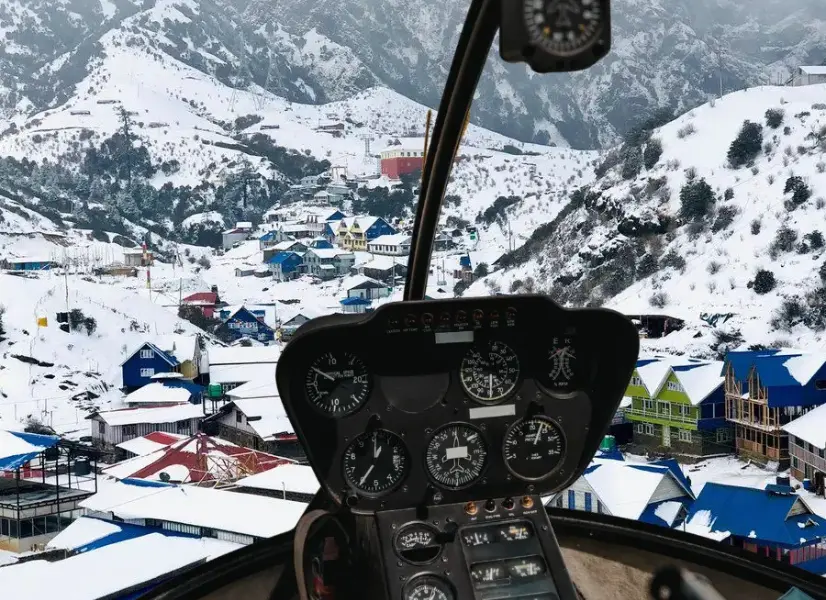
Your journey starts before most of Kathmandu wakes up. After a quick check-in and safety briefing, you board the helicopter and lift off. Watch the city give way to hills, then valleys, then the first jagged silhouettes of the Himalaya, a transformation that, on a clear morning, unfolds in astonishing detail right outside your window.
Flight from Kathmandu to Lukla
The helicopter banks toward Lukla, the traditional gateway to the Everest region, and Nepal's landscape unrolls beneath you the whole way. As Lukla approaches, the mountains start to dominate the horizon. Depending on the day's plan, the helicopter may touch down here briefly to refuel before pressing on toward the high Khumbu.
Flying Over the Everest Region
From Lukla, you climb deeper into the Khumbu, and the region's giants come into view one after another
- Mount Everest
- Lhotse
- Nuptse
- Ama Dablam
- Pumori
- Khumbu Glacier
- Khumbu Icefall
From up here, you take in the scale of this landscape in minutes — terrain that would otherwise take days of walking to see.
Landing at Kala Patthar
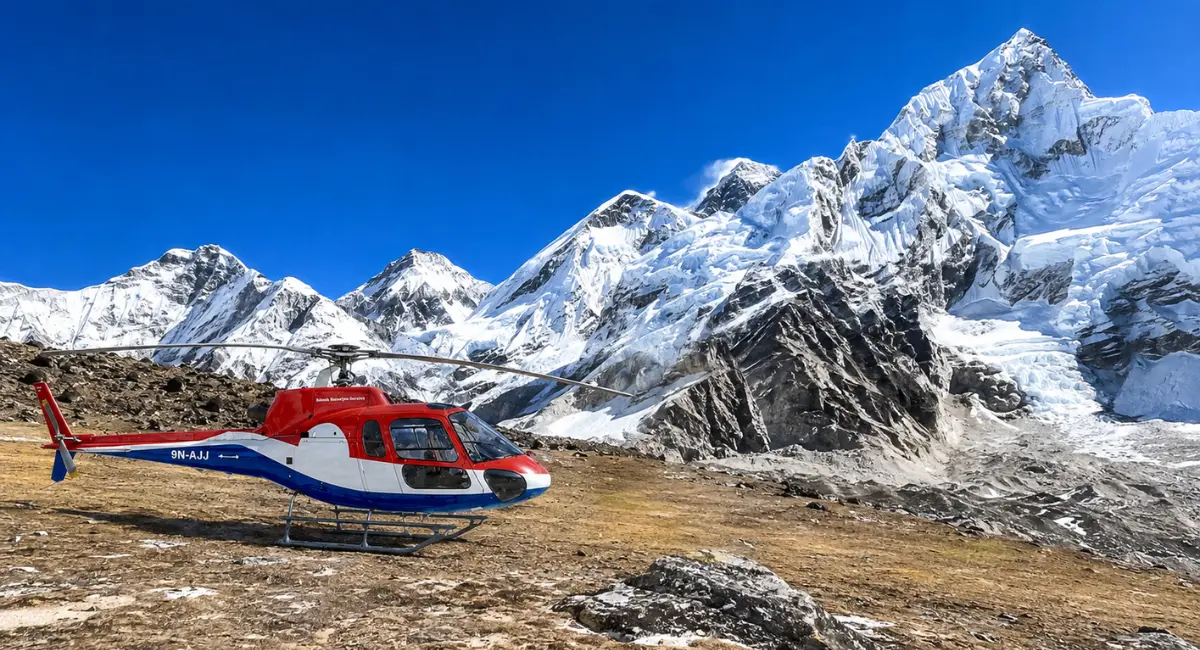
This is the moment most passengers remember longest. At roughly 5,545 metres, Kala Patthar puts Everest and its neighbouring peaks almost within arm's reach. Whether the pilot lands here depends on the weather, wind, visibility, and safety margins that day. The crew makes that call, not the itinerary on paper. When conditions do allow it, you'll typically have a short window on the ground, just enough time to step out, take in the view, and capture photos before climbing back aboard.
Everest Base Camp Flyover
Next, the helicopter sweeps over Everest Base Camp, arguably the most storied patch of ground in mountaineering, giving you a glacier's-eye view of the terrain climbers cross on their way to the summit. During peak climbing season, you may even spot expedition camps scattered across the ice below. Seeing Base Camp from above offers a completely different perspective than arriving on foot, and it's one of the best photo opportunities of the entire flight, weather permitting.
Breakfast at Hotel Everest View
Some packages build in a stop at Hotel Everest View, a lodge known for framing the mountain in nearly every window. Landing here lets you pause a fast-paced flight with a relaxed breakfast overlooking Everest and its neighbours, though whether this stop happens, and for how long, depends on your chosen package and the day's flying conditions.
Return Flight to Kathmandu
Once the sightseeing and any landings wrap up, the helicopter turns back toward Kathmandu, giving you one last look at the Himalaya before descending into the valley. From takeoff to touchdown, you'll have experienced the Everest region in a single day — no multi-week trek required.
Everest Base Camp and Kala Patthar Landing Experience
Few moments in Nepal compare to standing on Kala Patthar with Everest, Lhotse, Nuptse, and Pumori arrayed in front of you. At roughly 5,545 metres, the combination of thin air, dramatic glaciers, and an unobstructed mountain panorama makes it a favourite for photographers and anyone chasing a close-up Everest experience without walking the full trek.
That said, the landing isn't guaranteed on every flight. Weather, wind, visibility, helicopter performance, passenger weight, airspace rules, and local regulations all factor into the pilot's decision, and safety always wins over schedule.
When conditions line up, you'll get a short window to step off the helicopter, take in the scenery, and shoot photos. Because the altitude is significant, follow your pilot's instructions closely and skip any unnecessary exertion while you're up there.
For travellers short on time, pairing an Everest Base Camp & Kala Patthar Landing Helicopter Tour is one of the most efficient ways to experience this corner of the Himalayas.
What Mountains Can You See on the Everest Helicopter Tour?
As the helicopter climbs from Kathmandu's green valleys into the high Khumbu, an entire skyline of 6,000-, 7,000-, and 8,000-meter peaks opens up around you. Here's what you can expect to spot, weather permitting:
- Mount Everest (8,848.86 m): the world's highest point and the reason for the whole trip. From the air, its scale next to the surrounding giants becomes genuinely hard to comprehend.
- Lhotse (8,516 m): the fourth-highest mountain on Earth, standing shoulder to shoulder with Everest and instantly recognisable by its steep, unbroken face.
- Nuptse (7,855 m): Part of the jagged wall ringing Everest Base Camp, its sharp ridgelines dominate the view near the Khumbu Glacier.
- Ama Dablam (6,812 m): the region's most photogenic peak, its pyramid silhouette rising sharply above the surrounding valleys.
- Pumori (7,161 m): nicknamed the "Daughter of Everest", its snow-draped summit stands close to Base Camp.
- Cho Oyu (8,188 m): the sixth-highest mountain on the planet, visible in the distance along the Nepal–Tibet border on clear days.
- Thamserku (6,623 m): a jagged Khumbu peak that adds real drama to the skyline.
- Kongde Ri: a mountain massif towering over the Khumbu Valley near Lukla and Namche Bazaar.
- Khumbutse (6,665 m): Its snow ridges rise right beside the Khumbu Glacier near Base Camp.
- Lingtren (6,749 m): joins Pumori, Khumbutse, Everest, Lhotse, and Nuptse to complete the panorama that makes this flight so memorable.
Everest Helicopter Tour from Kathmandu
Departure Location
Flights typically leave Kathmandu early in the morning from the designated helicopter terminal, since visibility is usually best before the day heats up, though the exact schedule still bends to weather. Before boarding, you'll go through check-in, and the operator will confirm your details, baggage, and body weight.
Route
A typical flight path runs Kathmandu → Lukla → Everest Region → Everest Base Camp area → Kala Patthar → Hotel Everest View → Kathmandu—though weather, air traffic, and landing permissions can reshape it on any given day.
Flight Duration
The full experience, including flight time, a possible refuelling stop, sightseeing, a landing window, and any breakfast stop, generally runs several hours from departure to return.
Lukla Connection and Refueling
Lukla often serves as an operational stop for refuelling or passenger logistics before the helicopter pushes on toward higher altitudes. Whether it stops here depends on fuel needs, passenger load, weather, and the day's flight plan.
Flying Into the Everest Region
Past Lukla, you'll cross the Khumbu Valley and take in glaciers, mountain villages, and, visibility permitting, Everest, Lhotse, Nuptse, Ama Dablam, and Pumori.
Kala Patthar
Landing here, at around 5,545 metres, is often the highlight of the flight, though it hinges entirely on weather, wind, and safety conditions that day. The pilot has the final say.
Return to Kathmandu
After the scheduled stops, you'll head back to Kathmandu, sometimes via Hotel Everest View, closing out a single-day journey into the heart of the Himalaya.
How Long Is the Everest Base Camp Helicopter Tour?
Most tours run around 4–5 hours door-to-door, though weather, air traffic, refuelling, and your specific itinerary can stretch that. The total includes more than flight time; factor in pre-departure prep, the leg to Lukla, a possible refuelling stop, sightseeing over the Everest region, time at base camp, a potential Kala Patthar landing, and a breakfast stop if your package includes one.
Typical Time Breakdown
Build in some buffer beyond the scheduled flight time; Himalayan weather can affect the scheduled flight time and itinerary, and it doesn't always cooperate with a printed itinerary.
Best Time for an Everest Base Camp Helicopter Tour
Spring (March–May) and autumn (September–November) are the sweet spots, stable weather and excellent mountain visibility make both seasons a safe bet. Winter (December–February) can also deliver crystal-clear views, though temperatures at altitude turn extremely cold. Monsoon season (June–August) is the one to watch out for: clouds, rain, and reduced visibility drive up the odds of delays or cancellations. Flights can and do operate year-round when conditions allow, but spring and autumn remain the most reliable windows.
Weather Conditions and Flight Safety
Himalayan weather can turn on a dime, especially at altitude, so conditions get assessed continuously before and during the flight, and safety always takes priority over sticking to a fixed plan.
- Visibility: Clouds, fog, and haze can obscure the view and rule out certain landings.
- Wind: Strong gusts at high altitude can force a route change or scrap a planned landing entirely.
- Cloud cover: Clear skies over Kathmandu don't guarantee clear skies at Lukla, Base Camp, or Kala Patthar; conditions shift fast around the mountains.
- Snow: Fresh or accumulated snowfall can make certain landing sites unusable.
- Cancellations and delays: Build flexibility into your Nepal itinerary in case weather forces a reschedule.
- The pilot's call: Even with a landing built into your package, the pilot decides in real time whether it's safe to touch down.
- Rescheduling: If weather scrubs the flight, your operator will typically offer alternative arrangements per the booking terms, so check that policy before you pay.
Weight Limits and Passenger Restrictions
Weight matters more on a high-altitude helicopter flight than almost anywhere else, since altitude, temperature, fuel, and cabin load all interact to set the aircraft's real operating limit.
- Passenger weight: Expect to declare your body weight at booking or check-in so the operator can plan the flight accurately.
- Helicopter capacity: Available seats don't tell the whole story — combined passenger weight, luggage, and fuel all factor into how many people can safely fly.
- Weight distribution: Seating may be arranged for balance, not just comfort.
- High-altitude limitations: Altitude, temperature, and wind all affect helicopter performance and can influence where it's safe to land.
- Shuttle flights: If your group's combined weight exceeds safe limits for a route, the operator may split you across multiple flights.
- Luggage: Pack light; cabin space and weight allowances are both tight.
Give your operator accurate weight and baggage details when you book; it's how they keep everyone safe in the air.
Permits and Fees
Flying into the Everest region means flying through a protected, regulated aviation environment, so permits and fees can factor into your total cost depending on the route and landings involved.
- Sagarmatha National Park: The Khumbu sits inside this protected area, and entrance-related fees may apply depending on your itinerary.
- Landing permissions: Not every spot in the region is cleared for a helicopter landing on demand, approval and regulatory compliance come first.
- Aviation regulations: Nepal's aviation rules govern everything from airspace to landing sites, and operators must follow them.
- Applicable fees: Government, park, landing, or airport charges may be built into your total price.
Operator transparency: A trustworthy operator will spell out exactly what's included and what isn't; ask before you book rather than assuming.
Who Should Take an Everest Helicopter Tour?
- Travellers with limited time can see the Everest region without carving two-plus weeks out of their trip.
- Families: skip the long walking days, gear-heavy packing, and multiple lodge changes.
- Senior travellers enjoy the Himalayas without a strenuous multi-day trek while still keeping altitude in mind and checking with a doctor if they have health concerns.
- Luxury travellers go private or VIP for a fully personalised experience.
- Couples mark an anniversary, honeymoon, or birthday with a private flight over the world's highest mountain.
- First-time visitors to Nepal experience Everest without needing prior trekking or high-altitude experience.
- For anyone who can't commit to a multi-day trek physically or logistically, the helicopter opens up the region regardless.
Is the Everest Helicopter Tour Worth It?
For travellers who value time, comfort, and jaw-dropping aerial scenery, especially anyone who can't spare two-plus weeks, yes, this tour earns its price tag. If what you're really after is the walk itself, the cultural immersion, and the satisfaction of reaching Base Camp on your own two feet, the trek will likely mean more to you. The tour's biggest wins are speed and scenery: a single day instead of two weeks; sweeping views of Everest, Lhotse, Nuptse, Ama Dablam, and Pumori; and, conditions permitting, a landing at Kala Patthar itself. What it doesn't offer is the trek's slow immersion into Sherpa villages and mountain culture, and it costs more per trip. If time, comfort, and convenience top your list, this tour is hard to beat.
What to Expect During the Flight
Expect an early Kathmandu departure followed by a scenic climb into the Himalayan foothills and on toward the Khumbu. As you approach the mountains, panoramic views of peaks, valleys, glaciers, and villages open up below, possibly with an operational stop at Lukla along the way. You'll get an aerial pass over Everest Base Camp and its surrounding glaciers and, conditions allowing, a landing at Kala Patthar for a firsthand look at Everest up close. Some packages add a stop at Hotel Everest View for breakfast with a mountain backdrop. Throughout, you'll have plenty of chances to photograph the peaks, glaciers, and base camp before heading back to Kathmandu.
What to Bring
- Warm, windproof jacket: temperatures at Kala Patthar run far colder than Kathmandu.
- Gloves and a warm hat are essential if you step out at a high-altitude landing.
- Layered clothing makes it easy to adjust as temperatures swing.
- Comfortable, closed shoes with good grip for walking around the landing site.
- Sunglasses: sun and snow glare intensify sharply at altitude.
- Sunscreen: high-altitude sun is strong even in cold weather.
- Camera or smartphone: you'll want it for Everest, Kala Patthar, and the glaciers.
- Passport or ID as required by your operator.
- Water: stay hydrated throughout the flight.
- A small backpack rather than a bulky suitcase.
- Personal essentials, including any medications you need.
- Minimal luggage cabin space and weight limits are both tight.
Tip: Dress for two climates in one day; you may leave Kathmandu in mild weather and land somewhere close to freezing within the hour.
Photography Opportunities
- Aerial photography: capture mountain ridges, glaciers, valleys, and Himalayan villages at a scale the trekking trail simply can't match.
- Kala Patthar photography: when the landing happens, you get some of the most dramatic Everest shots available anywhere in Nepal.
- Everest Base Camp photography: the aerial angle offers a completely different take on this famous site and its surrounding glaciers.
A few tips: keep your camera or phone fully charged, bring a power bank if it's allowed, secure your gear with a strap, protect equipment from cold and moisture, clean your lens before shooting, follow every pilot instruction near the aircraft, stay well clear of the tail rotor, and grab the shot the moment conditions clear rather than waiting for perfection.
Important Things to Know Before Booking
- Weather changes fast. A clear Kathmandu morning doesn't guarantee clear skies over Everest.
- Schedules can shift. Weather, visibility, air traffic, and technical factors can delay, reroute, or cancel a flight.
- Landing isn't guaranteed. Treat a Kala Patthar landing as a possibility, not a promise.
- Weight limits apply. Give accurate passenger and baggage weight at booking.
- Passenger limits are strict. Group size alone doesn't determine how many people fly together; weight and aircraft capacity do.
- Read the cancellation policy before you pay, including how weather-related rescheduling works.
- Altitude is real. At around 5,545 metres, even a short visit to Kala Patthar means genuine high-altitude exposure; follow crew instructions and avoid overexertion.
- Expect an early start. Most flights depart early because morning conditions tend to favour clear mountain views.
Frequently Asked Questions
1. How much does the Everest Base Camp helicopter tour cost in 2026?
The price changes based on a few things: whether you fly shared or private, your group size, the route and stops you pick, whether a Kala Patthar landing is included, and what extras, transfers, breakfast, and permits come with the package. A solo traveller on a shared flight pays a different rate than a family chartering a private helicopter. Contact us directly, and we'll give you the current 2026 price for your specific group before you book.
2. How long does the Everest Base Camp helicopter tour take?
Most flights run about 4 to 5 hours from check-in to landing back in Kathmandu. The exact time can shift with a refuelling stop in Lukla, extra circling time for better visibility, a longer stay at Kala Patthar in good conditions, or airport delays. Keep your day loosely planned around this window rather than treating it as fixed.
3. Where does the tour depart from, and what happens before takeoff?
Flights leave from Kathmandu, usually from a private helicopter terminal rather than the main international one. Before boarding, you'll check in, get weighed along with your luggage, show ID, and go through a short safety briefing. We'll confirm your exact meeting point and pickup time once your booking is set; most flights depart early in the morning.
4. Can the helicopter land directly at Everest Base Camp?
No. Terrain, seasonal camp activity, and aviation rules rule out a direct landing at Base Camp. What you get instead is a close aerial pass right over it, low enough to see the tents, the glacier, and the icefall clearly. If your itinerary includes a landing, it happens at Kala Patthar or another approved site, not at Base Camp itself.
5. Will we actually land at Kala Patthar?
No operator can guarantee it. The landing depends on the weather that morning, wind speed at altitude, how the helicopter performs under those conditions, and the pilot's assessment of safety in real time. Spring and autumn generally offer more favorable weather and visibility, but a Kala Patthar landing is never guaranteed and remains subject to real-time conditions and the pilot’s safety assessment.
6. How high up is Kala Patthar?
It's about 5,545 metres, or 18,192 feet, higher than Everest Base Camp itself and well above where most people go without weeks of gradual altitude adjustment on foot.
7. Is this tour safe?
Flights follow standard aviation safety protocols with pilots experienced in these exact routes and terrain. Himalayan flying still involves thin air, shifting winds, sudden cloud cover, and dramatic terrain, which is why pilots have full authority to change the route, skip a landing, or turn back if conditions aren't right.
8. When's the best time of year to do this?
Spring (March to May) and autumn (September to November) bring the most stable weather and clearest mountain views. Winter can also offer clear skies, though temperatures at altitude drop sharply. Monsoon season (June to August) brings heavy cloud cover and rain, which makes delays and cancellations more likely.
9. Can kids come along?
Often yes, depending on the operator's age policy, aircraft capacity that day, and overall weight balance. Mention their ages when you book so we can confirm eligibility and make sure the flight works for your group.
10. Is this a reasonable option for older travellers?
Yes, it's one of the main reasons people choose it over trekking. You skip the multi-day walking and gradual altitude gain a trek requires. If a landing happens at Kala Patthar, the altitude still deserves caution even for a short visit, so let us know about any health considerations when you book.
11. What if the weather doesn't cooperate on the day of my flight?
Your flight might get delayed, rescheduled, rerouted to skip a landing, or in some cases, cancelled. Leave some flexibility in your Nepal itinerary and check the specific weather and cancellation policy before booking.
12. Does the price include breakfast?
Only if your package specifies it. Some itineraries stop at Hotel Everest View, where you eat breakfast with Everest and its neighbouring peaks visible through the window. Confirm with us before booking if breakfast matters to you, since not every route includes this stop.
13. Can I book the helicopter privately, just for my own group?
Yes. A private charter reserves the entire aircraft for you, your family, or your travel companions, within the seat and weight limits of the helicopter. It's a common choice for honeymoons, anniversaries, and family trips.
14. What's the difference between a shared and a private flight?
On a shared flight, you're paired with other travellers who booked separately, and the cost is split – the more affordable option. A private flight reserves the helicopter for your group only, at a higher price, with more control over timing and seating. Both options include the same scenery.
15. How many passengers can fly together?
It depends on the aircraft, the combined weight of passengers plus luggage and fuel, and how altitude affects performance that day. Larger groups sometimes get split across more than one flight to stay within safe limits. Tell us your group size when you book, and we'll confirm how the flights will be arranged.
16. Is this tour worth the money?
If your priority is limited time, physical comfort, and dramatic views without weeks of walking, most travellers find it worth the cost. If what draws you to Everest is the slow build of a multi-day trek, the villages, the tea houses, and the sense of earning the view, the trek will likely suit you better.
17. Do I have to trek to see Everest Base Camp?
No. The helicopter allows you to experience the Everest region by air and, subject to conditions, land at Kala Patthar without completing the full trek.
18. Will I actually see Mount Everest up close?
Yes, on a clear day. Everest, Lhotse, Nuptse, Ama Dablam, and Pumori all come into view during the flight, often close enough to make out individual ridgelines and snow features. Visibility depends on the weather that day.
19. Can I get out and take photos if we land at Kala Patthar?
If the landing happens and your pilot allows it, yes. You'll get a short window to step off the helicopter, take in the view, and take photos. Stay close to the group and follow the crew's instructions, since the altitude calls for careful, deliberate movement.
20. What should I wear?
Dress in layers you can add or remove as temperatures shift. Bring a warm, windproof jacket, gloves, and a hat in case you step out at altitude, along with warm socks, comfortable closed shoes with good grip, and sunglasses for the glare off the snow. Kathmandu can feel mild at departure, but temperatures at Kala Patthar can be extremely low; overdress rather than underdress.

Go Heli Services