

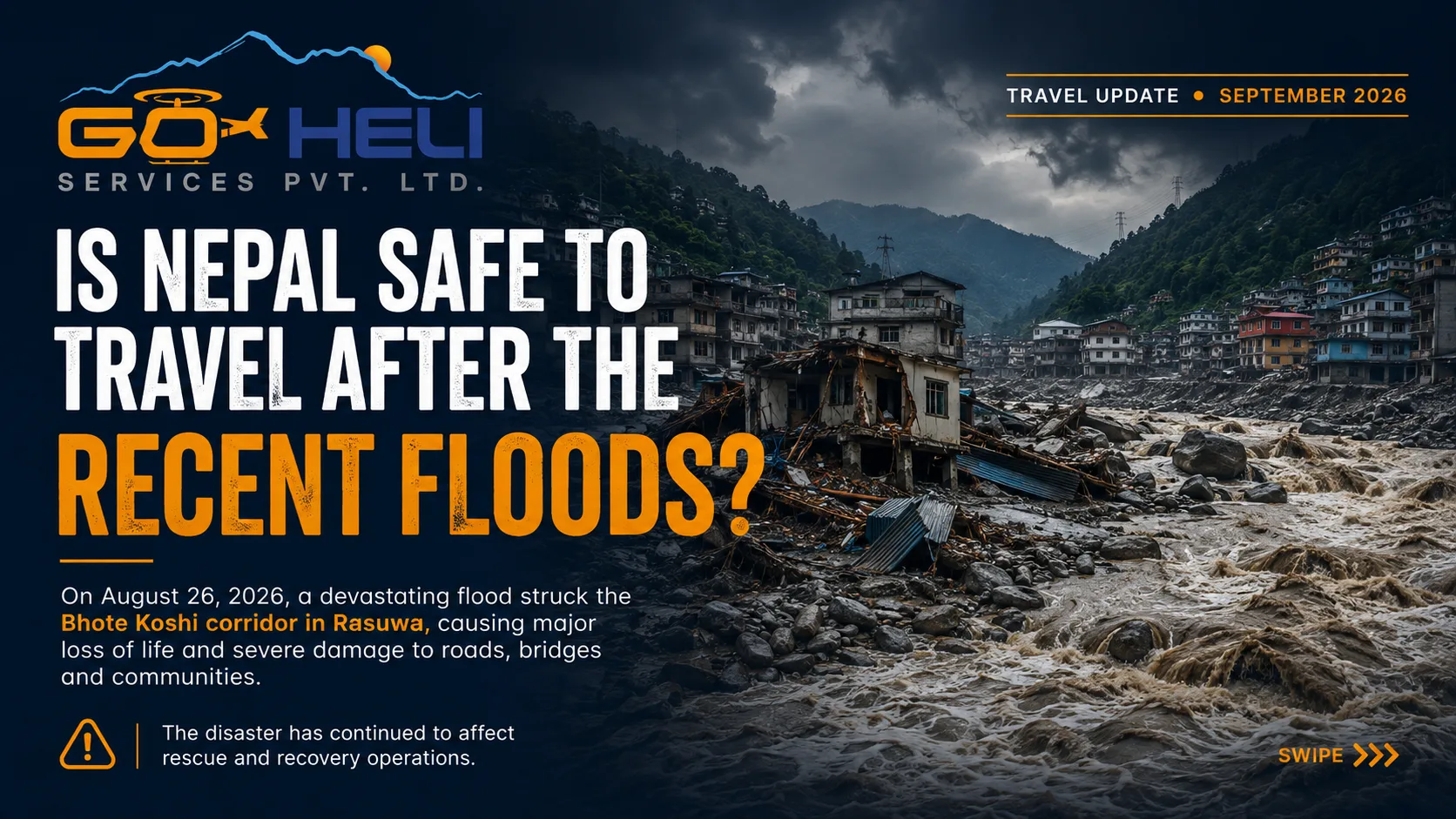
Is Nepal safe to visit after the Langtang flood? The images are heartbreaking. On August 26, 2026, a massive ice-rock collapse from the northern slope of Langtang Lirung triggered a devastating flash flood through the Bhotekoshi and Trishuli river corridors in Rasuwa district. Hundreds of lives were lost. Roads, bridges, villages, and hydropower infrastructure were swept away. It was one of Nepal’s worst natural disasters in recent memory. [IMPORTANT EVENT]
If you have a trip to Nepal planned — or you’re still thinking about it — you’re asking the same question millions of travelers worldwide are asking right now: is Nepal safe to visit after the flood?
Here’s the answer, backed by official data from the Trekking Agencies’ Association of Nepal (TAAN), the Nepal Tourism Board, and conditions on the ground: Nepal is open. Flights are running. The vast majority of trekking routes are unaffected. And your trip can go ahead. This guide gives you the full picture — what happened, what’s affected, what’s not, and exactly what you need to know before you fly.
Quick Answer: Is Nepal Safe to Travel Right Now?
Yes — for most destinations in Nepal, it is completely safe to travel right now.
The flood affected one specific river corridor in Rasuwa, Nuwakot, and parts of Dhading district. It did not touch the Everest region, the Annapurna region, Manaslu, Mustang, Pokhara, Kathmandu, Chitwan, or Lumbini. These destinations are open and operating normally.
If your Nepal itinerary doesn’t pass through the Rasuwa district or along the Bhotekoshi-Trishuli river corridor, the flood has zero impact on your travel plans.
What Happened in Langtang on August 26, 2026
On the morning of August 26, a colossal section of glacier ice and rock detached from the upper slopes of Langtang Lirung, approximately 5,000–5,500 metres above sea level. The mass plunged nearly 2,000 metres into the Lhende Khola river system below, generating a powerful debris-laden flood.
The flood surged through the Bhotekoshi corridor, devastating settlements in Timure, Syabrubesi, Mailung, and Betrawati before continuing downstream into the Trishuli River. It affected Rasuwa, Nuwakot, and Dhading districts.
What was destroyed:
- Roads and bridges connecting Syabrubesi to Dhunche
- The Pasang Lhamu Highway at Simtar
- Parts of the Syabrubesi market area
- Multiple hydropower projects (Chilime, Rasuwagadhi, Trishuli-3A)
- The Nepal-China border crossing at Rasuwagadhi
What was NOT affected:
- The Langtang Valley itself (upper valley including Kyanjin Gompa was not directly hit)
- The Everest region (separate drainage system, entirely different watershed)
- The Annapurna region (separate watershed, ~200 km west)
- Pokhara, Kathmandu, Chitwan, Lumbini
- Every major trekking region except Langtang’s access road
Why One Flood Does Not Mean All of Nepal Is Unsafe
This is the most important section of this article, because international news coverage has created a misleading impression.
Nepal covers 147,181 square kilometres. The flood-affected zone is concentrated along roughly 100 kilometres of one river corridor in three northern districts. That is less than 0.1% of the country’s total area.
The flood travelled along the Bhotekoshi-Trishuli river system. Nepal’s major trekking regions sit in completely different watersheds:
- Everest (Khumbu) drains into the Dudh Koshi system — hundreds of kilometres east, entirely separate.
- Annapurna drains into the Marsyangdi and Kali Gandaki systems — completely separate.
- Manaslu drains into the Budhi Gandaki — separate valley system.
- Mustang sits in a rain-shadow region behind the Himalayan crest — different geography entirely.
A flood in one river valley does not make another valley unsafe. Nepal’s mountain geography is defined by isolated river systems separated by massive Himalayan ridges. What happens in one has no effect on the others.
Official Status: Every Major Trekking Region in Nepal
TAAN has issued a formal safety assessment covering every major trekking and pilgrimage destination.
Regions Completely Unaffected
Regions With Adjusted Access
Flights Are Running — Domestic and International
International Flights
Tribhuvan International Airport in Kathmandu is operating on its normal schedule. All major international carriers are flying to Kathmandu as usual. Your arrival and departure plans should not change.
Domestic Flights
Mountain airports like Lukla and Jomsom can experience weather-related delays during monsoon season (August–September). This is normal for this time of year and not specific to the flood. Build buffer days into your itinerary — this is standard practice for any Nepal trip.
Helicopter Services
Helicopter operations are active across Nepal. The government has streamlined rescue operations under a single-window system. Tour operators, including Go Heli Services, continue to operate scheduled helicopter tours to Everest Base Camp, Annapurna Base Camp, Muktinath, Gosaikunda, and other unaffected destinations.
If you’ve booked a helicopter tour for autumn 2026, your booking stands. Routes to Everest, Annapurna, Mustang, and other major destinations are unaffected by the flood.
What About Langtang Specifically?
Langtang is the destination most travelers are asking about, so here’s the detailed answer.
The Langtang Valley itself was not directly hit by the flood. The destruction occurred along the access corridor — the roads and trails connecting Syabrubesi to Dhunche. The upper valley, including Kyanjin Gompa, was not damaged.
What’s Disrupted
- The road between Syabrubesi and Dhunche (swept away)
- Bridges along the Bhotekoshi corridor
- Parts of Syabrubesi market area
- The Pasang Lhamu Highway at Simtar
What’s Working
- The upper Langtang Valley trail is intact
- Kyanjin Gompa area was not directly affected
- An alternate trekking approach exists
Alternate Route to Langtang
TAAN has mapped a working alternate route that bypasses the damaged corridor entirely:
Kathmandu → Sundarijal → Chisapani → Thadepati → Ghoptebhir → Goshaikunda → Thulosyabru → Pairo → Lamahotel → Langtang → Kyanjin
This approaches from the Helambu side instead of the usual Syabrubesi entry point.
Timeline for Repairs
The main autumn trekking season runs October through November, giving several weeks for infrastructure repair. When the Lhende River last flooded in July 2025, one-way road access was restored in under two weeks. Road and trail repairs are expected to progress steadily.
If you have a Langtang trek booked: keep your booking and adjust timing or routing rather than cancelling. The destination is safe — only the standard access road is affected.
Nepal Is Calling — Why Your Trip Matters More Than Ever
On September 1, Nepal’s Minister for Culture, Tourism and Civil Aviation, Khadak Raj Paudel, released a video message on social media with the hashtag #NepalCalling:
“Our mountain trails and trekking routes are still waiting for you. Your coming to Nepal this time does not mean only a holiday. It’s a big support to the country fighting this catastrophic tragedy of flash floods.”
This isn’t just rhetoric. Tourism is a lifeline for Nepal’s economy.
- Tourism contributes approximately 6% of Nepal’s GDP directly, rising to roughly 10% when related industries are included
- Nepal welcomed 1.16 million visitors in 2025
- The industry supports hundreds of thousands of jobs — guides, porters, lodge owners, drivers, restaurant workers, hotel staff, and countless small businesses
- The floods damaged 142 hotels, 57 restaurants, 141 tourism vehicles, and 27 cultural heritage sites
- Reconstruction costs are estimated at $4–5 billion — nearly 10% of Nepal’s entire economy
A prolonged drop in tourist arrivals would devastate communities far beyond the flood-affected zone. When you visit Nepal’s open destinations this autumn, you’re not taking a risk — you’re directly supporting families and livelihoods that depend on tourism.
The message from the Nepal Tourism Board, PATA Nepal Chapter, and the Nepal Mountaineering Association is clear: don’t cancel your trip — adjust it if needed, and come.
Practical Travel Advice for Nepal (September–November 2026)
Before You Book
- Check whether your route touches Rasuwa. If your itinerary mentions Syabrubesi, Timure, the Bhotekoshi corridor, or the Kerung border crossing, talk to your operator about adjustments.
- If your itinerary doesn’t mention Rasuwa, proceed normally. Everest, Annapurna, Manaslu, Mustang, Pokhara, Kathmandu, Chitwan — all open, all operating.
- Book with a licensed, Nepal-based operator. They have real-time knowledge of ground conditions and can route you correctly.
If You’re Trekking
- Everest, Annapurna, Manaslu, Mustang, Kanchenjunga, Makalu — all confirmed safe by TAAN. Go ahead.
- Langtang — use the Sundarijal alternate route or wait for road repairs (expected before peak season).
- Manaslu Circuit — use Benighat-Arughat route (avoid Malekhu bridge).
- Carry travel insurance that covers helicopter evacuation and trip interruption.
- Build buffer days into your itinerary for potential weather-related delays.
If You’re Doing a Helicopter Tour
- Everest Base Camp, Annapurna Base Camp, Muktinath, Gosaikunda helicopter tours are all operating.
- Routes are unaffected by the flood.
- Weather can still cause delays during monsoon — keep 1–2 backup days.
General Monsoon Season Tips
- Avoid riverbanks after heavy rain
- Monitor updates from the Nepal Tourism Board and TAAN
- Keep copies of important documents in waterproof packaging
- Stay flexible — conditions can change quickly during monsoon
Frequently Asked Questions
Is Nepal safe to visit after the August 2026 flood?
Yes. The flood affected one river corridor in Rasuwa district. Nepal’s major tourist destinations — Everest, Annapurna, Pokhara, Kathmandu, Chitwan, and Lumbini — are completely unaffected and open to visitors.
Are flights to Nepal still operating?
Yes. Tribhuvan International Airport is operating normally. Domestic flights to Lukla, Pokhara, Chitwan, and other destinations are running on schedule.
Is the Everest Base Camp trek safe?
Yes. The Everest (Khumbu) region is in a completely separate watershed from the flood-affected area. Lukla flights are operating and the EBC trail is clear.
Is the Annapurna Circuit open?
Yes. The Annapurna region is unaffected. The Circuit, ABC, and Poon Hill treks are all operating normally.
Can I still do the Langtang Valley trek?
The valley itself is safe, but the standard access road through Syabrubesi is closed. An alternate route via Sundarijal → Chisapani → Goshaikunda → Langtang is available. Road repairs are expected before peak season.
Is Pokhara open for tourists?
Yes. Pokhara is fully operational. Adventure activities including paragliding and bungee jumping are running normally.
Should I cancel my Nepal trip?
No. If your itinerary doesn’t pass through Rasuwa district, there is no reason to cancel. For trips that do touch the affected area, adjust your routing or timing rather than cancelling. Your visit supports Nepal’s recovery.
Is it safe to fly within Nepal during monsoon?
Yes, with normal precautions. Mountain airports like Lukla and Jomsom can experience weather-related delays during monsoon. Build buffer days into your itinerary. This is standard practice for any Nepal trip.
The Mountains Are Still Standing. The Trails Are Still Open.
Nepal has faced disasters before — earthquakes, floods, avalanches — and every time, the country has rebuilt. The Langtang flood was devastating, but it struck one corridor in one corner of a vast, mountainous country.
The Himalayas are still standing. Everest, Annapurna, Manaslu, and Kanchenjunga are untouched. The teahouses are serving dal bhat. The guides are working. The trails are waiting.
As the Nepal Tourism Board says: the best way to support Nepal right now is not to stay away. It’s to come — and to travel where it’s safe.
If you have questions about current helicopter tour availability, updated trekking itineraries, or the status of any specific route, contact Go Heli Services — we’re a Nepal-based operator with real-time knowledge of conditions on the ground, and we’ll give you an honest answer about what’s running and what’s not.
Ready to plan your Nepal trip? Get instant availability and pricing on WhatsApp: +977 9851434266 — or browse our full range of helicopter tours in Nepal.
Last updated: September 3, 2026. Conditions in Nepal can change during monsoon season. Always confirm current status with your operator and the Nepal Tourism Board before departure.

Go Heli Services