

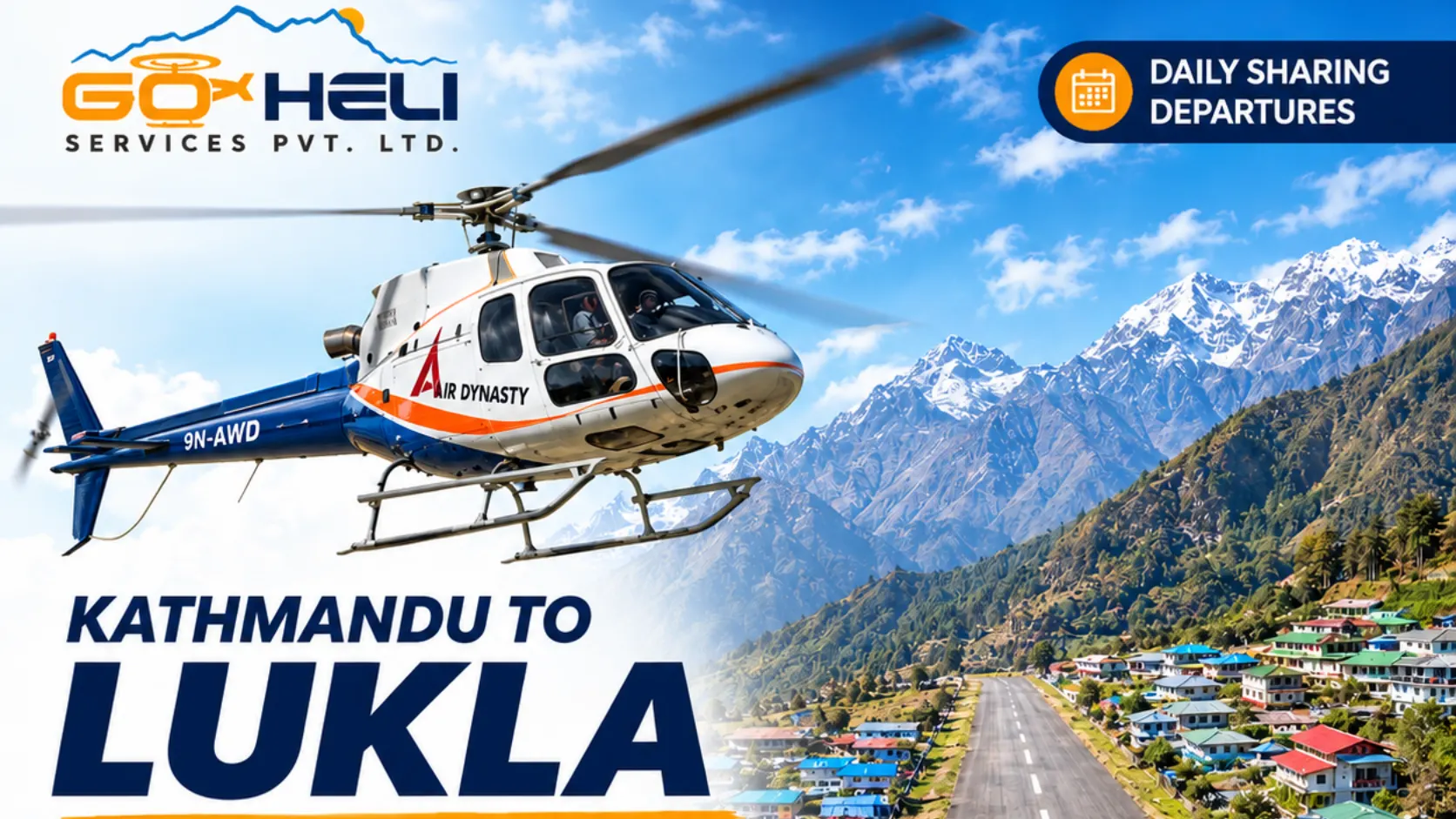
Complete 2026 booking guide for the Kathmandu → Lukla route — real sharing and private charter prices, what is included, hidden fees, the Ramechhap detour, safety, and how to book without getting overcharged.
Kathmandu to Lukla Helicopter Flight
The Real Cost of a Kathmandu to Lukla Helicopter Flight in 2026
Every Everest Base Camp trek starts with the same question: how do I get to Lukla?
Lukla (2,860 m) is the main gateway to the Everest region. No road reaches it, so the practical options are a small fixed-wing plane or a helicopter flight from Kathmandu. And if you have spent more than ten minutes on trekking forums, you already know the story: Lukla flights get cancelled, delayed, and diverted — especially in the busy spring and autumn trekking seasons.
That is exactly why the Kathmandu to Lukla helicopter flight has become a popular way to start an Everest trek. It takes around 40 to 50 minutes, departs from the Kathmandu domestic airport even in peak season when fixed-wing services shift to Ramechhap, and — subject to weather and operational conditions — can get you into Lukla the same morning.
A note on pricing: the rates in this guide were verified in September 2026. Helicopter fares vary with the season, passenger count, total weight, aircraft availability, and prevailing weather, so always confirm the final quoted price for your dates.
This guide breaks down the real Kathmandu to Lukla helicopter cost in 2026 — sharing prices, private charter rates, hidden fees, luggage rules, and how to book without surprises. We arrange these flights every season, so the numbers below reflect current market pricing, not inflated brochure figures.
Kathmandu to Lukla Helicopter Flight Cost at a Glance
Key point: the sharing price you pay depends on how many seats are filled that day, the season, and the operator's fuel and aircraft availability at the time. Most agencies quote between US$ 450 and US$ 600 per person for a shared seat. A private charter costs US$ 2,500 to US$ 3,500 for the whole helicopter — which becomes very affordable when a group of 4–5 people splits it.
What Is Included in the Price — and What Is Not
Nothing frustrates travelers more than a "cheap" price that balloons with added fees. Here is what a standard Kathmandu to Lukla helicopter flight price should include, and what you may need to pay separately.
Included in most quoted prices:
- One-way helicopter flight from Kathmandu (KTM) to Lukla (LUA)
- Experienced high-altitude mountain pilot and crew
- Pre-flight safety briefing
- Emergency oxygen and in-flight safety equipment
- Government taxes and helicopter fuel charges
- Scenic aerial views along the Khumbu route
Not included (ask your operator):
- Kathmandu domestic airport tax (approx. NPR 400 / US$ 3 per person)
- Lukla airport tax (approx. NPR 500 / US$ 4)
- Meals and refreshments
- Personal travel insurance
- Extra baggage above the weight allowance
- Tips for the pilot and crew
Tip: when comparing quotes, always ask for the final out-the-door price including taxes. A US$ 450 quote can quickly become US$ 500+ once airport taxes are added. Go Heli Services quotes all-inclusive pricing, so the rate you confirm at booking is the rate you pay at the helipad.
Kathmandu to Lukla Helicopter vs the Ramechhap (Manthali) Detour
Here is the single most important thing to understand about flying to Lukla in 2026 — and it is a key reason many trekkers switch to helicopters.
During peak trekking seasons (March to May and September to November), most fixed-wing services to Lukla operate from Ramechhap rather than Kathmandu. Because of air-traffic congestion at Tribhuvan International Airport, the Civil Aviation Authority of Nepal (CAAN) has moved Lukla's fixed-wing rotations to Manthali Airport in Ramechhap district — roughly a 4 to 5 hour drive east of Kathmandu.
Here is what that means in practice for plane passengers:
- Wake up around 1:00–2:00 AM to reach Manthali by early morning
- Spend 4–5 hours on a mountain road before boarding
- Fly the short 20–25 minute Ramechhap → Lukla leg
- Spend the better part of a full day on travel, plus road-transfer costs
A helicopter, by contrast, departs from the Kathmandu domestic airport throughout the main trekking seasons — avoiding the Ramechhap drive entirely, subject always to weather, visibility, and aircraft availability.
Bottom line: the plane ticket looks cheaper on paper. But once you add the 4–5 hour drive, the overnight stress, the missed trekking day, and the risk of cancellation, the helicopter is often the smarter financial decision for travelers with limited time.
The rerouting of Lukla's peak-season fixed-wing flights and the operational rules for mountain airfields both follow CAAN regulations for Nepal's domestic airports. Helicopters operate within the same visual-flight-rules (VFR) framework, so weather — not the aircraft type alone — is always the final gate.
Helicopter vs Plane to Lukla: Which Should You Choose?
Both options are safe and legal; they simply behave differently on this route.
Fixed-Wing Plane
- Cost: US$ 236–257 per person (Kathmandu), US$ 175–199 (Ramechhap)
- Flight time: 30–35 minutes from Kathmandu, 20–25 from Ramechhap
- Baggage: 10 kg checked + 5 kg hand carry (strict)
- Airlines: Tara Air, Summit Air, Sita Air, Yeti Airlines, Goma Air
- Pros: lowest ticket price, more scheduled seats available
- Cons: rerouted to Ramechhap in peak season, cancels more readily in marginal weather, strict weight limits, bumpier ride at higher altitude
Helicopter
- Cost: US$ 450–600 per person (sharing), US$ 2,500–3,500 (private charter)
- Flight time: 40–50 minutes direct from Kathmandu
- Baggage: 10–15 kg per person (more flexible)
- Operators: Air Dynasty, Manang Air, Fishtail Air, Shree Airlines, Simrik Air, Mountain Helicopter, Kailash Heli, Altitude Air
- Pros: departs from Kathmandu in the main seasons, generally less exposed to the Ramechhap drive, flies lower for closer mountain views, more comfortable cabin
- Cons: 2–3x the plane ticket price
When to choose the helicopter
- You are on a tight schedule (3–10 day window for your trek)
- You have an international flight connection to protect
- Your group has 4–5 people (a private charter becomes cost-effective)
- You want to skip the 4–5 hour Ramechhap drive entirely
- It is peak season and you prefer not to gamble on fixed-wing weather slots
What Factors Affect the Kathmandu to Lukla Helicopter Cost?
Prices are not fixed year-round. Here is what moves them.
1. Season and Demand
- Peak season (March–May, Sep–Nov): high demand, prices toward the top of the range, shared seats fill within days
- Shoulder season (Feb, Jun, Dec): moderate prices, easier to arrange
- Off-season (monsoon Jul–Aug): lower demand but riskier weather; fewer flights operate
2. Sharing vs Private
Shared seat: you pay only for your seat. Cheaper per person, but you wait for the helicopter to fill, and the departure time is set by the operator's morning rotation.
Private charter: you pay for the whole aircraft. You choose the departure time, bring more luggage, and never wait for strangers. Ideal for 4–5 people — the per-person cost drops dramatically.
3. Total Weight (Passenger + Baggage)
Helicopters have a strict maximum takeoff weight — usually 450–550 kg including passengers, baggage, and fuel. If your group's combined weight is high, the operator may:
- Reduce the luggage allowance
- Split the group across two flights
- Recommend a private charter
Always provide accurate passenger weights at booking. This is the #1 cause of last-minute surprises at the helipad.
4. Last-Minute Bookings
Booking 1–2 days before departure in peak season can push prices up 10–20% — or cost you a seat entirely. Book 2–4 weeks ahead for the best rate.
5. Aircraft Type
Most operators use the Airbus H125 (AS350 B3e) — a helicopter designed for high-altitude performance and widely used for mountain operations across Nepal. Some operators reserve twin-engine models (such as the H130 or Bell 407) for certain routes, which costs more. For a standard Kathmandu–Lukla shuttle, the H125 is the industry norm.
Flight Duration, Route, and What You Will See
The Kathmandu to Lukla helicopter flight takes 40 to 50 minutes — a little longer than the plane because helicopters fly lower and follow the river valleys rather than cutting straight over passes.
The flight sequence:
- Takeoff: domestic terminal, Tribhuvan International Airport (typically 6:30–8:00 AM)
- Valley crossing: green hills, terraced farms, and the sunrise-lit Kathmandu Valley
- River valleys: the helicopter tracks the Dudh Koshi corridor through dramatic gorges and waterfalls
- Mountain transition: dense pine and rhododendron forests give way to rugged high-altitude terrain
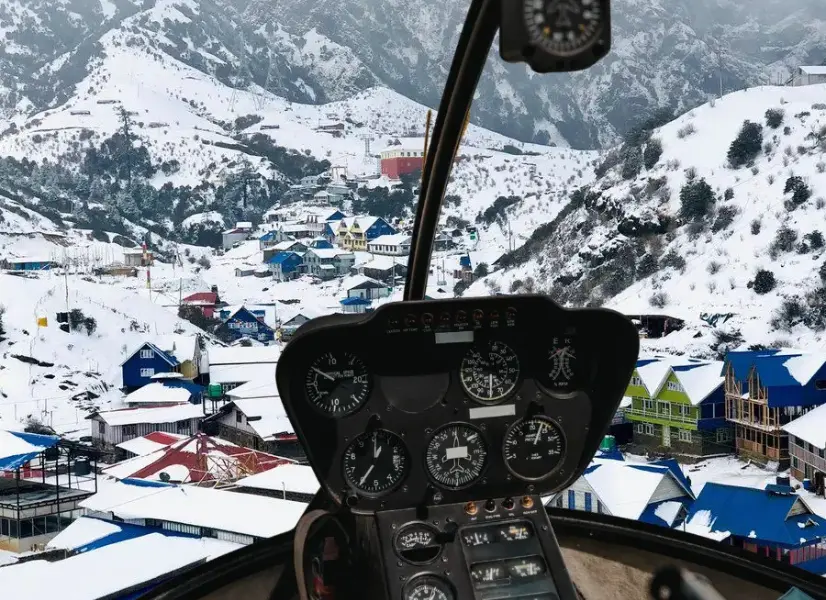
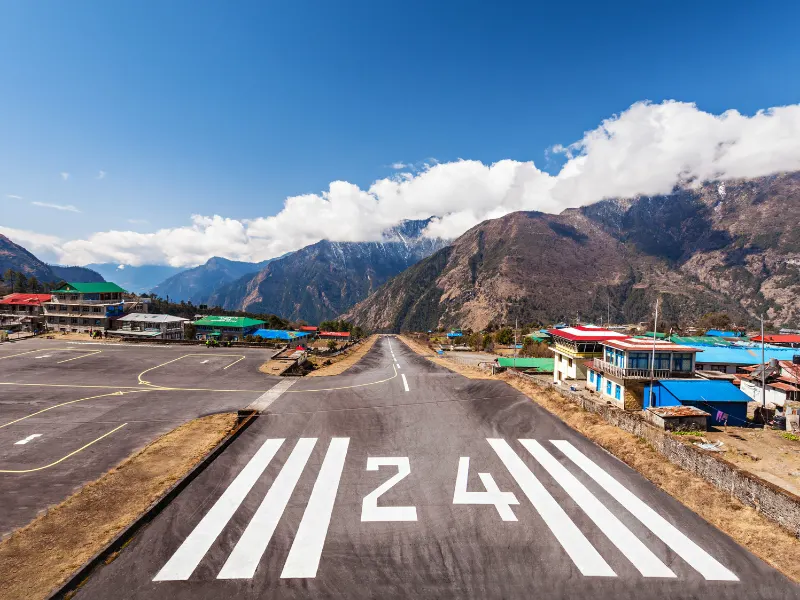
- Landing: Tenzing-Hillary Airport (LUKLA), one of the world's most famous mountain runways
Helicopters typically fly at around 10,000–12,000 feet — low enough to clearly see villages, monasteries, and the folds of the Himalaya. On clear days you get close-up views of peaks towering over 8,000 meters before you even start trekking.
Note on refueling: some flights make a short technical stop at Manthali Airport to refuel, depending on wind, load, and air traffic. This is normal and safe, and it usually adds about 15 minutes to the journey.
Luggage Rules and Weight Limits for Helicopter Flights
Practical packing tips:
- Keep your helicopter baggage to 10 kg even if 15 kg is allowed — it keeps the flight within safety margins and avoids weight-based shuttle splits
- Trekking poles must be packed, not carried loose
- Carry your passport, permit documents, camera, and a warm layer in your hand baggageLukla mornings are cold — wear a down jacket regardless of the season
The Flight Day: Step-by-Step Timeline
A Kathmandu to Lukla helicopter flight with Go Heli Services typically runs like this:
Day Before
- Confirm your departure time via WhatsApp or email
- Receive your weight and luggage briefing
- Get your exact meeting point at the domestic airport
Flight Day (Morning)
After landing: most trekkers continue the same day to Phakding (about 3–4 hours of easy walking with an early start) — the classic first day of the Everest Base Camp trek.
Best Time to Take the Kathmandu to Lukla Helicopter
Morning flights are strongly preferred for the safest experience. Mountain weather builds through the day; by mid-afternoon cloud cover can close the route. Operators schedule most departures before 9:00 AM.
Season-by-season:
- Spring (March–May): clear skies and blooming rhododendrons; helicopters run most days. High demand — book 3–4 weeks ahead.
- Autumn (September–November): the most popular season — post-monsoon skies, strong visibility, stable mornings. October is typically the busiest month.
- Winter (December–February): flights continue, mornings are crisp and clear, but temperatures at Lukla drop sharply. Good for crowd-avoiders.
- Monsoon (June–August): weather risk is highest — persistent cloud and rain can ground flights for days. Allow extra buffer days if you trek in monsoon.
Golden rule: never schedule your international departure within 24 hours of a planned Lukla return. Weather can always intervene, and one buffer day in Kathmandu is far cheaper than a missed flight home.
Is the Helicopter Flight to Lukla Safe?
Aviation safety in the Himalaya comes down to three things: a well-maintained aircraft, an experienced mountain pilot, and disciplined operational decisions by the operator. Both planes and helicopters serving Lukla are operated under regulations set by Nepal's Civil Aviation Authority (CAAN), and the route is flown only under Visual Flight Rules (VFR), when visibility and wind are within safe limits.
On that basis, here is what we can say factually about helicopter operations on this route:
- Proven aircraft: the Airbus H125 (AS350 B3) is designed for high-altitude performance and is widely used for mountain flights and rescue work across Nepal. It is certified for very high elevation landings.
- Experienced pilots: Nepal's regulations require pilots on the Lukla route to hold mountain-flying experience. Your pilot will have flown this corridor many times.
- Operational planning: operators monitor the weather closely and hold or reschedule flights whenever conditions fall below safe minimums.
- Emergency capability: if conditions deteriorate, a helicopter can in many cases turn back or divert to a lower-altitude landing site — an option fixed-wing aircraft use in more limited forms.
- On-board equipment: high-altitude charters carry emergency oxygen, and reputable agencies use licensed helicopters with passenger liability insurance.
What you cannot control: the weather. No flight — plane or helicopter — can be guaranteed in the Himalaya. What you can control is who you fly with: a licensed operator with route experience, transparent pricing, and a safety-first policy. Go Heli Services arranges flights with CAAN-licensed partner helicopters and Everest-route pilots.
How to Book Your Kathmandu to Lukla Helicopter Flight
Step 1 — Pick Your Flight Type
Shared seat if you are 1–2 travelers and flexible on time. Private charter if you are 3–5 travelers, on a fixed schedule, or want extra luggage room.
Step 2 — Get a Confirmed All-Inclusive Quote
Send your travel date, number of passengers, and total baggage weight. A reputable operator confirms the final price in writing — including taxes — so there are no surprises on the day. Rates verified in September 2026 may differ on your travel date, so confirm at booking.
Step 3 — Book with a Small Deposit
Most operators ask for a US$ 100–200 deposit per person to lock the seat, with the balance due on flight day. In peak season seats sell out — book early.
Step 4 — Travel Day
Show up at the domestic airport with your passport. Your operator handles check-in, briefing, boarding, and luggage.
[How to Book Kathmandu to Lukla Helicopter Flight – Complete Guide]
This guide will help you understand the booking process before you confirm your flight.
The Return Leg: Lukla to Kathmandu Helicopter Flight
What goes up must come down. The Lukla to Kathmandu helicopter flight follows the same route in reverse — 40 to 50 minutes back to the capital.
This return flight is often the more valuable leg:
- Skip 3 days of downhill trekking from Everest Base Camp back to Lukla
- Avoid the 4–5 hour Ramechhap drive that fixed-wing passengers face in peak season
- Protect your international flight connection — get back to Kathmandu the same day
- Fly out of Lukla even when planes are grounded for weather
Many Himalayan treks now include a helicopter return as standard — a trend that accelerated sharply in 2026. The days of the purely "walk-down" trek are giving way to a smarter hybrid: trek up, helicopter back.
Why Book Your Kathmandu to Lukla Helicopter with Go Heli Services?
Go Heli Services Pvt. Ltd. is a registered Nepal helicopter charter and travel company based in Thamel, Kathmandu, arranging Everest-region flights every season.
- All-inclusive pricing: the US$ 600 shared rate and US$ 3,000 private charter include government taxes — no hidden airport fees
- Direct departures from Kathmandu: we fly from the Kathmandu domestic airport through the main seasons, bypassing the Ramechhap detour
- Licensed CAAN partner operators: flights are arranged with established companies — including Air Dynasty, Manang Air, Fishtail Air, and partners — that also fly Everest rescue missions
- Flexible shared departures: daily morning rotations with window-view seating
- Transparent process: rates confirmed in writing at booking and reviewed seasonally (last verified September 2026)
- Established track record: 5.0-rated reviews on Google and TripAdvisor
- 24/7 WhatsApp support: +977 9851434266
Frequently Asked Questions
How much does a helicopter from Kathmandu to Lukla cost?
A shared Kathmandu to Lukla helicopter flight costs US$ 450–600 per person. A private charter costs US$ 2,500–3,500 for the whole helicopter (up to 5 passengers). Go Heli Services offers a shared seat at US$ 600 and a private charter at US$ 3,000, all taxes included. Rates vary by season and availability — confirm your date at booking.
How long is the Kathmandu to Lukla helicopter flight?
40–50 minutes directly from the Kathmandu domestic airport to Tenzing-Hillary Airport (Lukla), depending on weather, routing, and whether a refueling stop at Manthali is needed.
Are there helicopter flights from Kathmandu to Lukla every day?
Helicopter departures run from Kathmandu on most days through the main trekking seasons, subject to weather and aircraft availability. Unlike fixed-wing planes, helicopters are not shifted to Ramechhap, so the departure point stays in Kathmandu whenever conditions allow.
What is the cheapest way to fly to Lukla?
The lowest ticket price is a fixed-wing plane (US$ 175–257), but in peak season it requires a 4–5 hour drive to Ramechhap. For the best balance of cost and certainty, a shared helicopter seat (US$ 450–600) departs directly from Kathmandu.
Can I take a helicopter from Lukla back to Kathmandu?
Yes. The Lukla to Kathmandu helicopter flight takes 40–50 minutes and saves about three days of downhill trekking. It is one of the most requested helicopter returns in the Everest region.
How much luggage can I take on the helicopter?
10–15 kg per person, subject to the helicopter's total weight limit (450–550 kg including passengers and fuel). Keeping to 10 kg helps avoid weight-based shuttle splits.
Is the helicopter flight to Lukla as safe as flying by plane?
In general, helicopters can operate in a wider range of conditions than fixed-wing aircraft on this route, but neither option is risk-free and both fly only when weather allows. The key safety factors — aircraft maintenance, pilot experience, and operator discipline — are regulated by CAAN for both.
When is the best time for a Kathmandu to Lukla helicopter?
October and April offer the best combination of clear weather and peak-season demand. Autumn (September–November) generally offers the most stable flying conditions.
Can I book a helicopter flight from Kathmandu to Lukla on the same day as my arrival?
Often yes — helicopters run flexible morning rotations and can sometimes accommodate same-day departures if seats and weather allow. This is one reason travelers with tight itineraries choose a helicopter.
Do I need a deposit to book a Lukla helicopter?
Most operators ask for a US$ 100–200 deposit per person to confirm the seat, with the balance payable on the flight day.
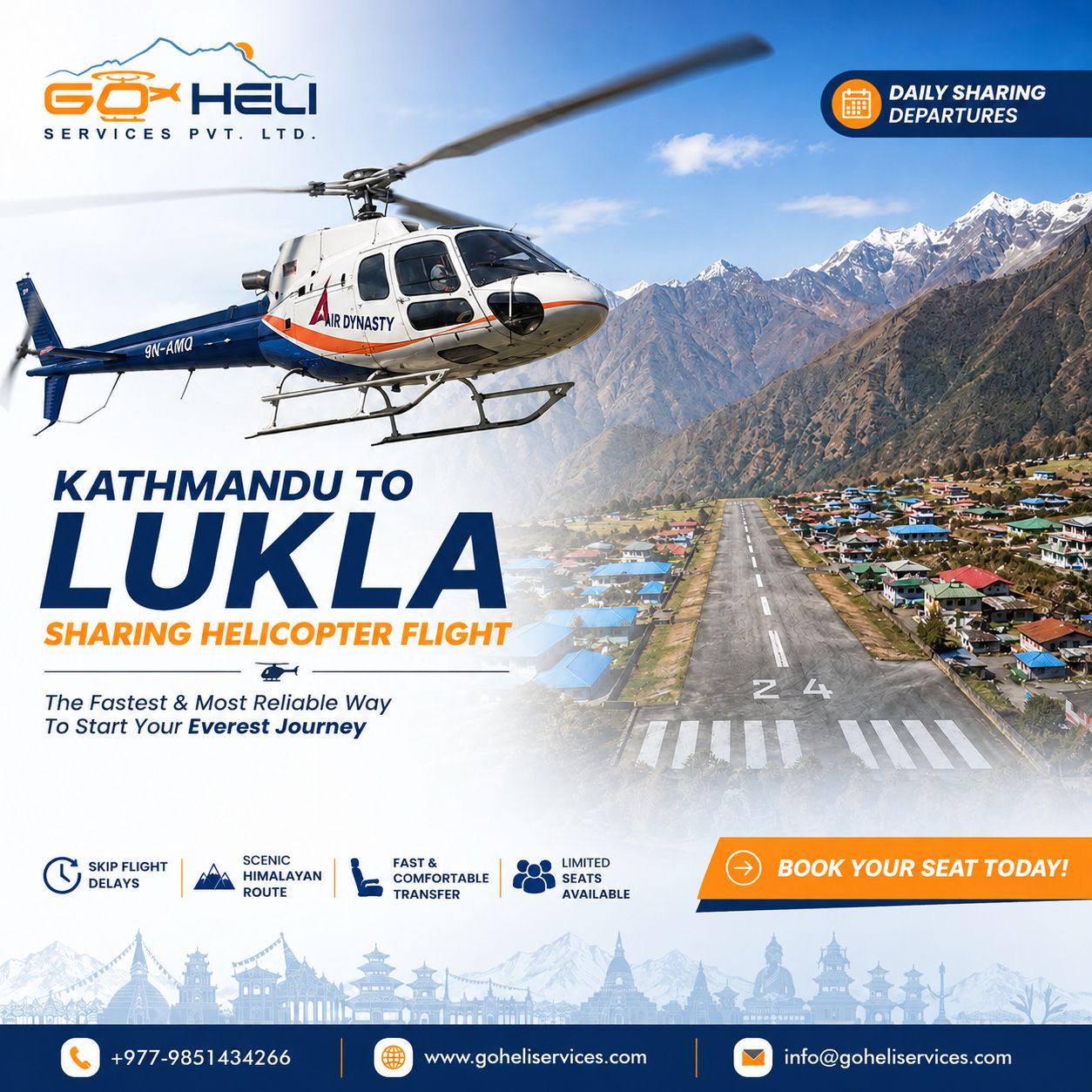
Ready to Fly to Lukla?
Your Everest trek should begin with the one thing every traveler worries about: a confirmed flight. With the Kathmandu to Lukla helicopter, you get direct departures from Kathmandu, time saved on the Ramechhap detour, and a scenic start to your journey — rather than a 2 AM wake-up call and a 5-hour drive.
Book your Kathmandu to Lukla helicopter flight with Go Heli Services today:
- Shared seat: US$ 600 per person
- Private charter: US$ 3,000 for up to 5 passengers
- Email: info@goheliservices.com
- WhatsApp / Call: +977 9851434266
- Office: Thamel, Kathmandu
Book Your Kathmandu to Lukla Helicopter Flight →
Return: Lukla to Kathmandu Helicopter Flight →

Go Heli Services