


Lukla to Everest Base Camp Helicopter Tour 2026: Cost, Route & Kala Patthar Landing
Complete 2026 guide to the Lukla → Everest Base Camp helicopter flight — shared and private charter pricing, the exact flight path, the Kala Patthar landing, weight rules, and who this flight is actually for.
Quick answer: a Lukla to Everest Base Camp helicopter tour costs US$ 550 per person on a shared seat, or US$ 2,100 for a private charter carrying up to 5 passengers. The one-way flight takes about 1.5 to 2 hours and lands at Kala Patthar (5,545 m), the closest helicopter-accessible viewpoint to Mount Everest. Helicopters do not land on the glacier at Everest Base Camp itself.
Written by the Go Heli Services Nepal Operations Team (Thamel, Kathmandu). Prices verified September 2026.
How Much Does a Lukla to Everest Base Camp Helicopter Tour Cost?
A shared Lukla to Everest Base Camp helicopter flight costs US$ 550 per person, and a private charter costs US$ 2,100 for the whole helicopter. Because the charter seats up to five, a group of four brings the private rate down to US$ 525 per person — effectively matching the shared seat while keeping the entire aircraft to yourselves.
This is the flight for travelers who are already in Lukla — whether you landed by fixed-wing plane after trekking in from somewhere, or you flew the Kathmandu to Lukla helicopter instead. From Lukla, the Khumbu valley opens up, and a helicopter puts you at Kala Patthar in under two hours rather than six days of walking.
A note on pricing: the rates below were verified in September 2026. Mountain aviation fares move with season, passenger count, total group weight, aircraft availability and prevailing weather, so always confirm the final quoted price for your specific dates.
Lukla to Everest Base Camp Helicopter Price at a Glance
How the private charter divides by group size:
Key point: at four passengers, the private charter is US$ 25 cheaper per person than the shared seat. Most operators quote US$ 2,500–3,500 for a comparable private Everest flight, so the math favours chartering earlier rather than later in your planning.
The Flight Route: Lukla to Kala Patthar Step by Step
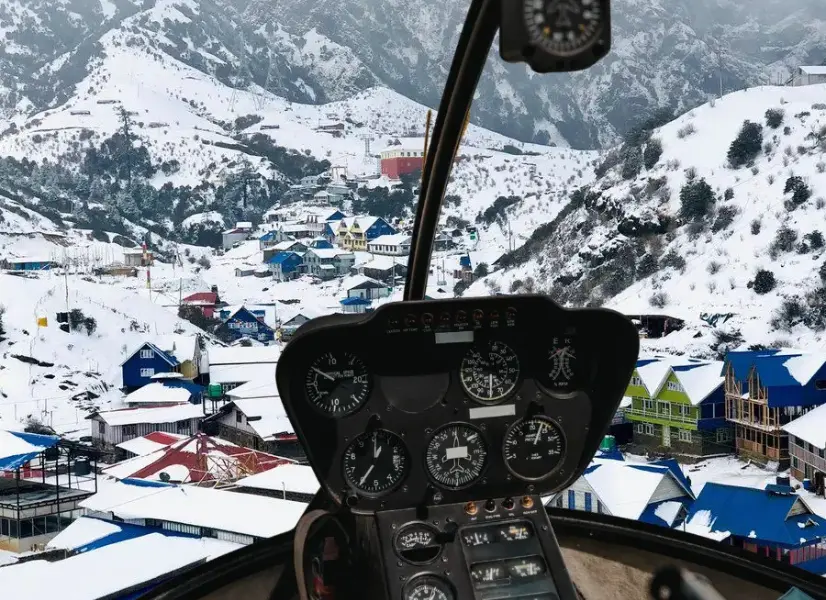
The route climbs the Khumbu valley in stages, gaining roughly 2,700 metres of altitude in under two hours. Each stage corresponds to a stage of the classic Everest Base Camp trek — you are simply flying the same corridor trekkers walk.
Pheriche is the important stop. It is the last point where the helicopter can carry a full load. Above this village, thin air limits how much weight the aircraft can lift safely, so groups larger than three are split into smaller shuttles for the final climb to Kala Patthar. Your pilot will brief you on this before departure.
Because the Khumbu valley is a deep glacial trough, the flight path zig-zags rather than climbing straight. It is a longer route in kilometres and a shorter one in time — the helicopter effectively cuts across switchbacks that take trekkers three days on foot.
The Kala Patthar Landing: Altitude, Ground Time and What You See
Kala Patthar at 5,545 m is the highest point most Everest visitors ever reach without climbing equipment. The landing puts you on a rocky ridge roughly 180 m above Everest Base Camp, and about 3 km from the summit, with an unobstructed south-west view of Mount Everest.
A typical ground stop runs 10 to 20 minutes. That is deliberate. Time at 5,545 m is limited to reduce altitude exposure for you and to keep the rotor-turn cycles efficient for the aircraft, so pilots treat the stop as a scheduled operational window rather than an open-ended visit.
What is genuinely worth doing in that window:
- Walk a short section of the ridge for a viewpoint away from the landing point
- Photograph Everest's south-west face, Lhotse (8,516 m) and Nuptse (7,861 m)
- Look down the Western Cwm toward the Khumbu Glacier
- Watch the Khumbu Icefall, the most dangerous section of the actual Everest climbing route
Altitudes you will pass on this flight
Note on published figures: you will see Kala Patthar quoted online as 5,364 m, 5,535 m, 5,545 m, 5,555 m, 5,600 m and 5,644 m by different operators. The widely used survey figure is 5,545 m (18,192 ft). Everest Base Camp is 5,364 m and is lower. If a page claims helicopters land at Everest Base Camp, it is confusing the base camp with the viewpoint above it.
Why Helicopters Do Not Land at Everest Base Camp
Helicopters do not land at Everest Base Camp. They land at Kala Patthar, roughly 180 m higher, and the reason is the ground itself: Everest Base Camp sits on moving glacier ice.
A glacier is not a solid surface. Ice flows downhill continuously, creating crevasses, seracs and pressure ridges that shift throughout the day. A helipad cannot be built on it, and a rotorcraft cannot safely settle on it. Kala Patthar, by contrast, is stable rock — a ridge that has held its position while the glacier beneath it moves.
A second factor is regulatory. Everest Base Camp is a working expedition base, and overnight stays there are restricted to climbers holding summit permits. Tour operators land at the viewpoint above instead, which keeps commercial traffic clear of the expedition area. Reported accounts of a formal CAAN prohibition on EBC landings date from 2021, but the terrain argument alone is decisive regardless of the regulatory status — you cannot land on moving ice.
Who Is the Lukla to Everest Base Camp Helicopter Tour For?
This flight suits a specific and fairly large group of travelers. Here is an honest breakdown.
Trekkers who flew or hiked to Lukla and want the mountain
You have already paid to get to 2,860 m. Rather than walk six days to Gorakshep, you can be at Kala Patthar and back in a single morning — and still have time to continue trekking if the weather turns.
Trekkers finishing the EBC trek who want to skip the descent
The standard return from Gorakshep to Lukla is three to four days of downhill. Flying out replaces them with a single flight. If you have already walked up, this is the single best value-for-money helicopter flight in Nepal.
Families, older travelers and anyone with limited mobility
There is no fitness requirement. If walking 15 km a day at 4,000 m is not realistic, this flight delivers the Everest experience without the physical demand.
Photographers
Kala Patthar is the highest accessible viewpoint of Everest's south-west face. A sunrise landing puts the summit in low-angle light with the Khumbu Glacier below — a shot that cannot be replicated on foot without a 5,555 m dawn climb.
Who it is not for
If you have a spare two weeks and want the full trail experience, trek. The helicopter shows you the top of the mountain, not the journey. Budget-conscious travelers on a long itinerary are usually better served by the Everest Base Camp Trek with Helicopter Return, which gives you both.
How Does This Flight Connect With Kathmandu to Lukla?
Most travelers book this route as a two-leg chain, and understanding it prevents an expensive mistake.
The critical detail: this flight starts at Lukla, not Kathmandu. There is no pickup from your Kathmandu hotel included. If you want the door-to-door version, that is the separate Everest Base Camp Helicopter Tour — a 4 to 5 hour round trip that includes the Kathmandu–Lukla leg either way.
If you are flying into Lukla first, read our Kathmandu to Lukla helicopter cost guide for the Ramechhap rerouting issue that catches many travelers out in peak season — fixed-wing services shift east during spring and autumn, adding a 4 to 5 hour drive that helicopters avoid entirely.
The Reverse Route: Everest Base Camp to Lukla by Helicopter
The same corridor runs in the other direction, and for trekkers it is usually the more valuable of the two flights. Flying down from Everest Base Camp area saves three to four days of descent and is the single most requested helicopter flight in the Everest region.
The practical advantage: the descent from Gorakshep is downhill but it is still three to four days of walking on uneven ground at altitude, carrying everything you own. A helicopter replaces that with a comfortable flight while you are still at your most tired.
Best Time to Fly Lukla to Everest Base Camp
March to May and September to November offer the best combination of visibility, stable weather and reliable flying. October and April are generally the strongest months. These are the same windows that define Nepal's trekking seasons, because mountain aviation depends on exactly the conditions trekkers depend on.
Timing the flight within a day matters as much as timing the season. Mountain wind builds through the morning, so most Everest helicopter flights depart just after first light — typically a 6:30 to 7:30 AM hotel pickup in Lukla for a takeoff around 7:00 to 7:30. Flying earlier also means you reach Kala Patthar in low-angle light, which is the best of the day for photography.
Winter is not closed. It offers the crispest visibility of the year and very few clouds, but daylight is short, colder air reduces aircraft performance at altitude, and weather windows are tighter. If you want a light-rail look at the summit, go then and accept a higher risk of a stand-down.
Weight Limits and the Three-Passenger Rule Above 4,000 m
Above approximately 4,500 m, thin air sharply reduces how much weight a helicopter can lift safely. In practice this produces two rules that every operator follows, and understanding them removes most surprises on the day.
- Maximum three passengers per flight above 4,500 m. Groups larger than three are split into shuttles.
- Combined passenger weight above that altitude is capped at approximately 250 kg including hand luggage.
This is why the helicopter flies to Pheriche (4,371 m) as one group, then ferries smaller parties up to Kala Patthar and back. The total airborne time is longer, and passengers in later shuttles wait at Pheriche in the sun. On a group of five, expect roughly three rotations for the final segment.
Baggage for this flight:
- Bring 10 kg maximum per person
- Soft-sided bags only — no hard suitcases or trekking poles
- No packed hot food or pressurised items
- Leave porters, duffels and hired gear behind if you are not returning to trek
Exceeding these limits does not mean you cannot fly. It means the flight plan changes, and in some conditions it means the Kala Patthar leg cannot be flown on the day. Keep the weight conversation honest with your operator at booking, not at the helipad.
Is Lukla to Everest Base Camp Helicopter Flying Safe?
No mountain flight is risk-free, and any operator who tells you otherwise is overselling. What you can assess is whether the operator is honest about risk and properly regulated.
What is regulated and verifiable:
- The Civil Aviation Authority of Nepal (CAAN) licenses every commercial operator and pilot flying in Nepal
- Aircraft must hold a current airworthiness certificate and pass scheduled maintenance
- Pilots flying the Everest region hold high-altitude and mountain flying qualifications
- Flights operate under visual flight rules (VFR) — pilots must maintain visual contact with terrain and weather throughout
What genuinely determines your risk level:
- Pilot hours on the Khumbu route. Experience in this specific valley matters more than total hours.
- Whether the operator will stand down. No responsible pilot flies because a customer is on a tight schedule.
- Aircraft choice. The Airbus AS350 B3e (H125) is the standard mountain helicopter here, chosen for its performance at altitude.
- Honest briefing. If your operator cannot explain the Pheriche shuttle, the weight cap and the stand-down policy, that is a signal.
The honest summary: this is a well-regulated, routinely operated route flown by thousands of passengers every season. The margin for error is genuinely smaller at 5,545 m than at sea level, and the variables that matter — weather, visibility, wind — are outside anyone's control. Choose a licensed operator, ask about pilot mountain experience, and accept that a delayed flight is a normal outcome, not a failure.
What to Pack for the Lukla to Everest Base Camp Helicopter Flight
This is a short flight and you are walking on rock for 10 to 20 minutes at 5,545 m, not trekking. Pack accordingly and leave the rest with your porter or lodge.
Essential:
- Warm layered clothing — a base layer, fleece and windproof shell
- Sunglasses — snow and glacier glare is intense
- Sun protection — high-altitude UV burns skin quickly
- A camera or phone, plus a spare battery (cold drains them fast)
- A small daypack, 10 kg maximum
- Passport and necessary travel documents
Worth adding:
- Light gloves for the ground stop
- A compact beanie for the ridge
- Lip balm with SPF — high-altitude air is extremely dry
- Cash in Nepali Rupees for tea at Pheriche if you are waiting through shuttles
Do not bring: hard suitcases, trekking poles, heavy camera tripods, large duffels, or anything you would struggle to lift into a cabin with 3 people and 10 kg of hand luggage each.
How to Book Your Lukla to Everest Base Camp Helicopter Tour
Booking this flight is straightforward once you know the three things that determine your quote.
1. Confirm the starting point. This is a Lukla departure. Make sure you know how you will reach Lukla airport and how long before departure you need to arrive. If you are coming from Kathmandu the same morning, build in a large buffer — you would need the earlier Kathmandu to Lukla helicopter, and a delay on that leg should not strand you.
2. Give an accurate total group weight. Weight determines the Pheriche shuttle plan and can affect whether the Kala Patthar segment is flyable on the day. Estimates are fine at booking; corrections later are not.
3. Ask what is included. Confirm whether permits, airport fees, a Kala Patthar landing and any Everest View Hotel stop are inside the quoted price. Meals at Hotel Everest View are a common optional extra — published prices for a breakfast there run US$ 35–45 per person [CONFIRM] — as is the Everest National Park entry permit, quoted by operators at US$ 30 plus US$ 20 in taxes [CONFIRM]. Go Heli Services confirms inclusions in writing before payment.
Deposits: most operators ask for US$ 100–200 per person to secure the seat, with the balance payable on the flight day. Shared seats are subject to seat availability on the morning departure.
Frequently Asked Questions
How much does a helicopter from Lukla to Everest Base Camp cost?
US$ 550 per person on a shared seat, or US$ 2,100 for a private charter carrying up to 5 passengers. At four passengers the charter works out to US$ 525 per person, slightly cheaper than the shared seat. Go Heli Services quotes both rates with taxes confirmed at booking.
How long is the Lukla to Everest Base Camp helicopter flight?
About 1.5 to 2 hours one way, flying roughly 40 km from Lukla to Kala Patthar and including a 10 to 20 minute landing. Block time is longer if the group is split into shuttles above Pheriche.
Does the helicopter land at Everest Base Camp?
No. It lands at Kala Patthar (5,545 m), roughly 180 m above Everest Base Camp. Everest Base Camp sits on moving glacier ice, which cannot support a landing. Kala Patthar offers a closer and better view of the summit anyway.
Do I need to fly from Kathmandu to Lukla first?
Yes. This flight departs from Lukla (2,860 m) and does not include a Kathmandu pickup. Most travelers reach Lukla by helicopter in 40–50 minutes, or by fixed-wing plane for US$ 175–257. You need to be in Lukla the night before.
Can I use this flight to skip the descent from Everest Base Camp?
Yes, and this is its most popular use. Trekkers finishing the EBC trek fly the reverse route from Everest Base Camp to Lukla in 15–20 minutes, replacing three to four days of downhill walking.
How many people can fly above 4,500 m?
Three passengers maximum per flight, with a combined weight of about 250 kg including luggage. Groups larger than three are split into shuttles at Pheriche, the last point where a full load can be carried.
Is a Kala Patthar landing always possible?
No. It depends on wind, visibility and the aircraft's payload on the day. Kala Patthar is a high-altitude landing with a 10 to 20 minute ground window, and in marginal conditions an operator may fly the overflight only. Ask your operator how they handle a stand-down before you book.
What luggage can I take?
10 kg per person, soft-sided bags only. No hard suitcases, trekking poles or large camera tripods. Excess weight forces shuttle splits and can affect whether the Kala Patthar leg is flyable.
What is the best month to fly from Lukla to Everest Base Camp?
October and April offer the best balance of clear skies and stable weather. The broader windows are March–May and September–November. Early morning departures give you the best light on the summit.
Can elderly travelers or children fly this route?
Yes. There is no fitness requirement and it is one of the most popular flights for families and senior travelers. Anyone landing at 5,545 m should be comfortable with short walks at altitude, and should disclose heart, respiratory or pregnancy conditions before booking.
Is the helicopter flight from Lukla to Everest Base Camp safe?
Like any high-altitude mountain flight, it carries real risk. The route is routinely operated under CAAN regulation by licensed, mountain-qualified pilots flying the standard AS350 B3e. Choose an operator who will explain the stand-down policy and who pilots have logged on the Khumbu route.
Ready to See Everest Base Camp from the Air?
If you are already in Lukla, the decision is simple: two and a half hours of walking gets you to Namche, six days gets you to Gorakshep, and a helicopter gets you to Kala Patthar — 5,545 m, 180 m above Everest Base Camp — before lunch.
Book your Lukla to Everest Base Camp helicopter tour with Go Heli Services:
- Shared seat: US$ 550 per person
- Private charter: US$ 2,100 for up to 5 passengers
- Email: info@goheliservices.com
- WhatsApp / Call: +977 9851434266
- Office: Thamel, Kathmandu
Book Your Lukla to Everest Base Camp Helicopter Tour →
Related Everest helicopter routes from Go Heli Services
Everest Base Camp to Lukla Helicopter Flight →
Everest Base Camp Helicopter Tour (Kathmandu round trip) →
Everest Base Camp & Kala Patthar Landing Helicopter Tour →
Everest Base Camp & Gokyo Lake Landing Helicopter Tour →
Gokyo to Lukla Helicopter Flight →
Tengboche to Lukla Helicopter Flight →
Namche to Everest Base Camp Helicopter Tour →
Everest Base Camp Trek with Helicopter Return →
Daily Helicopter Flight Schedule →
Why Book With Go Heli Services
Go Heli Services Pvt. Ltd. is a registered Nepal helicopter charter and travel company based in Thamel, Kathmandu, arranging Everest-region flights every season.
- All-inclusive pricing: the US$ 550 shared seat and US$ 2,100 private charter are confirmed in writing before payment, with government taxes itemised
- Licensed CAAN partner operators: flights are arranged with established mountain operators flying the Airbus AS350 B3e, which also handle Everest-region rescue work
- Honest stand-down policy: if conditions do not permit the Kala Patthar landing, we fly the overflight and tell you why — we do not promise landings we cannot guarantee
- Transparent weight planning: we ask for accurate group weights at booking so the Pheriche shuttle plan is right before you arrive
- Established track record: 5.0-rated reviews on Google and TripAdvisor
- 24/7 WhatsApp support: +977 9851434266

Go Heli Services