

Tihar is the week Nepal turns its homes, shops, and temple courtyards into a field of small flames. For five days, families light diyo along doorways, hang marigold garlands, honor the animals that share their lives, and welcome the goddess Laxmi into clean, open houses. In 2026, Tihar in Nepal runs from Saturday 7 November to Wednesday 11 November, with Laxmi Puja on Sunday 8 November and Bhai Tika on Wednesday 11 November.
It is Nepal’s second-biggest festival after Dashain and one of the best weeks to visit: clear weather, sharp mountain views, and a warm, social mood. But Tihar is not a performance. It is a family festival with quiet rituals, and it rewards visitors who slow down, ask first, and join in with respect.
Quick answer: Tihar 2026 runs 7–11 November (Kartik 21–25, 2083 BS). Kaag Tihar is 7 November; Kukur Tihar and Laxmi Puja are 8 November; Gai Tihar is 9 November; Goru Tihar, Govardhan Puja, Mha Puja, and Nepal Sambat 1147 fall on 10 November; Bhai Tika is 11 November. The Government of Nepal holiday runs 8–12 November. Expect busy transport and some of the clearest mountain views of the year. Book hotels, domestic flights, and helicopter seats early. Helicopters fly in daylight, so enjoy the lamp-lit streets on foot after sunset.
Last-minute note for 2026: Tihar starts on 7 November. Hotels and transport are still available in Kathmandu and Pokhara, but popular helicopter seats may already be gone. Contact operators directly for current availability.
What Is Tihar?
Tihar (तिहार) is a five-day Hindu festival celebrated across Nepal. It is also known as Yamapanchak, Deepawali, and, among the Newar community of the Kathmandu Valley, Swanti. The festival honors Yama, the god of death; Laxmi, the goddess of wealth; the animals that support human life; and the bond between brothers and sisters.
Tihar is often called Nepal’s Festival of Lights because of the oil lamps, candles, and electric lights that transform homes and streets after dark. But it is also a festival of gratitude: each day thanks a different part of life — the crow, the dog, the cow, the ox, the goddess Laxmi, and the siblings who protect one another. The lights are a welcome, a prayer, and a statement that darkness will not have the final word.
For visitors, Tihar is one of the most accessible ways to see Nepali family life: dogs wearing marigold garlands, children singing at doorways, shopkeepers lighting lamps, and neighbors exchanging sweets. There are quiet moments too — a grandmother arranging offerings, a father helping a child light a diyo. For the wider festival calendar, see our guide to festivals in Nepal.
Key names: Tihar, Yamapanchak, Deepawali, Swanti, Bhai Tika, and Mha Puja.
Tihar Dates 2026
Tihar follows the lunar calendar, so the dates move every year. The table below uses the official Kathmandu Metropolitan City calendar.
The Government of Nepal has announced a five-day Tihar holiday from 8 to 12 November 2026. Government offices and public institutions will remain closed during this period. Banks, private businesses, shops, and other services may follow their own holiday schedules. Tourist hotels, selected restaurants, and transport services may continue operating with adjusted hours. Confirm availability before visiting.
Local puja timings, especially the auspicious hour for Bhai Tika, are announced by Nepal’s calendar authorities and can vary by community. Confirm the exact time with your hotel, guide, or host.
Best days for visitors: If you have one day, choose Laxmi Puja on 8 November — the night the country lights up. If you have two, add Bhai Tika on 11 November. For Newar culture, make time for Mha Puja on 10 November in Patan or Bhaktapur.
Five Days of Tihar
Tihar is not one celebration repeated five times. Each day has its own focus, food, and mood. The sequence moves from the smallest and most overlooked creatures to the closest human relationships.
Day 1: Kaag Tihar — The Crow
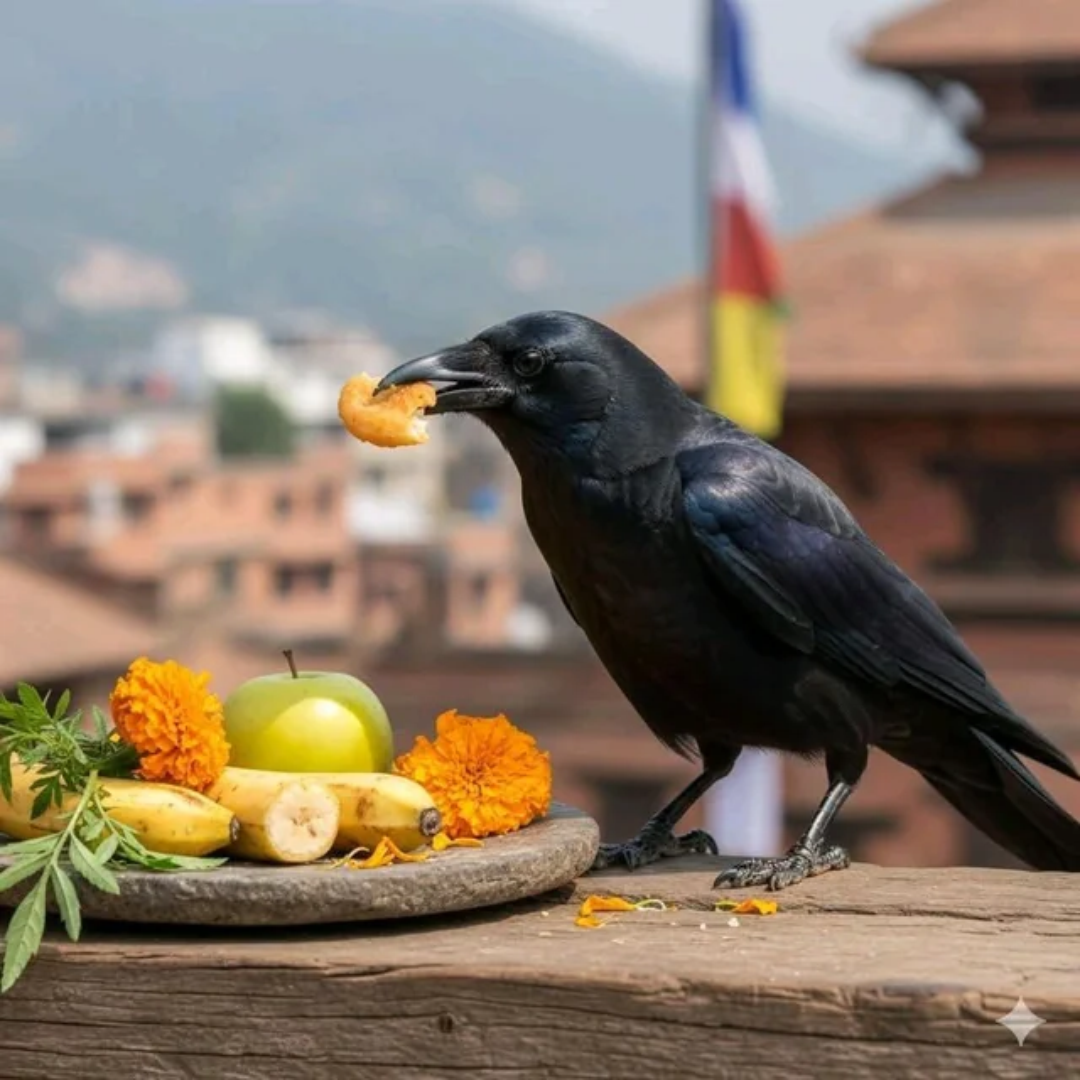
In Hindu belief, the crow is a messenger of Yama, and its call is traditionally associated with news, including difficult news. On Kaag Tihar, families turn that association into an act of respect. They place small leaf plates of rice, grain, sweets, and other food on rooftops, balconies, and courtyard walls, then call the crows to eat.
It is a quiet day. The offerings are small, the rituals domestic, and the streets not yet full — a good morning for a walk through Patan, Asan, or the lanes around Kathmandu Durbar Square.
Traveler tip: Kaag Tihar is subtle: look up, walk slowly, and save your energy for Laxmi Puja.
Day 2: Kukur Tihar and Laxmi Puja — The Dog and the Goddess of Wealth
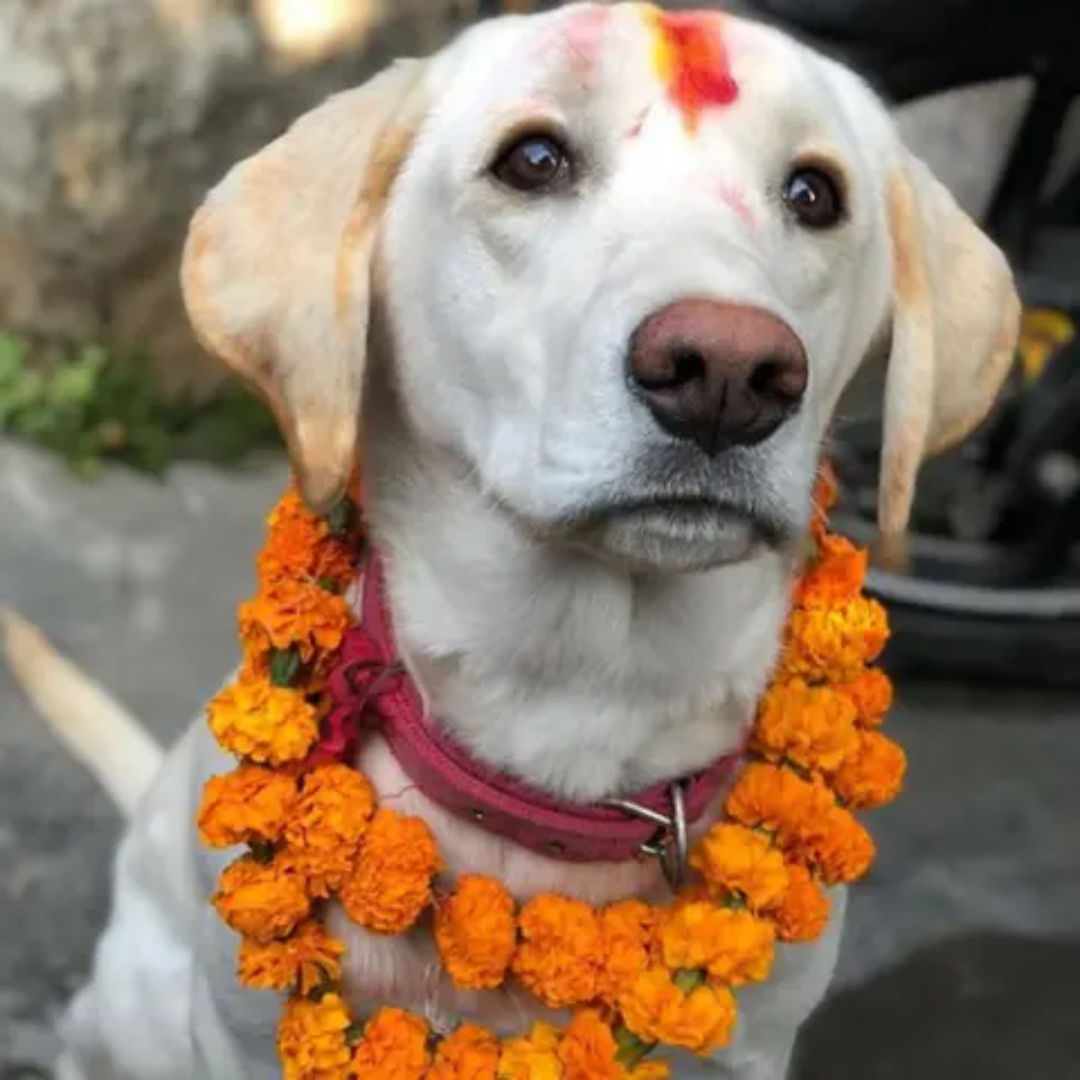
The second day belongs to dogs, and it delights visitors. Dogs are honored as loyal guardians and, in Hindu tradition, as creatures connected with Yama. Families and shopkeepers apply a red tika, hang a marigold garland, and offer a special meal to pets, strays, guard dogs, and police dogs.
Traveler tip: Ask before petting a dog, and never disturb one while it is eating. A plain biscuit is enough if you want to offer something.
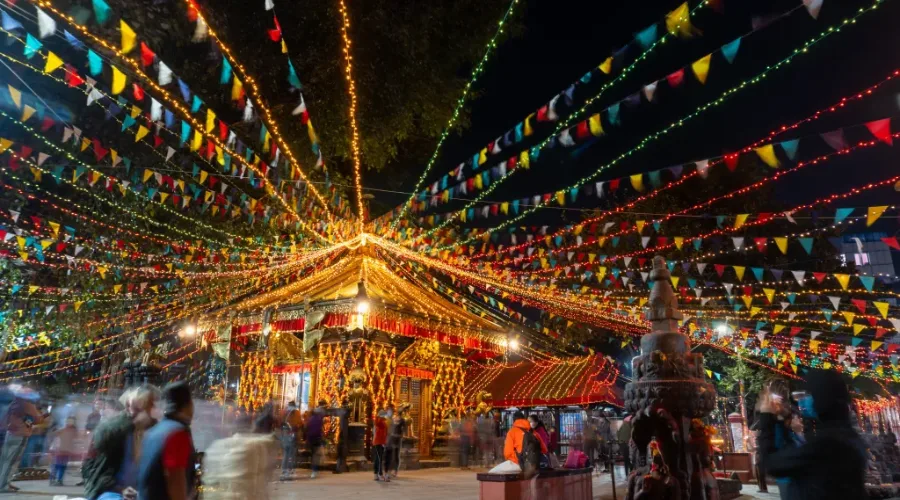
In the evening, the festival becomes spectacular. Laxmi Puja is the main night of Tihar. Families clean and decorate their homes, draw rangoli at the threshold, light rows of diyo along windows and doorways, and leave doors and windows open so the goddess can enter. Some trace small footprints from the door to the family altar, a symbolic path for Laxmi. Shopkeepers perform puja for their businesses, and the streets fill with incense, marigold, and frying sel roti.
The belief behind the lights is simple: Laxmi visits clean, bright, welcoming homes. A dark house is a closed house. So people light every corner, not to show off, but to invite.
Traveler tip: Plan an early dinner and walk after sunset, when the lamps are freshly lit. Thamel, Patan, Bhaktapur, and the lanes around Swayambhunath are atmospheric; rooftop viewpoints show the valley sparkling below. Ask before photographing inside homes or during private puja.
Day 3: Gai Tihar — The Cow
The third day honors the cow, a symbol of motherhood, nourishment, and prosperity. The cow is washed, marked with tika, draped with a garland, and fed fresh grass and treats. In many households, the cow is understood as a form of Laxmi herself. Gai Tihar is a quieter, family-centered day, and many shops remain closed.
Traveler tip: If you are invited to a home, let your host lead. Do not touch the cow’s offerings or interrupt the feeding.
Day 4: Goru Tihar, Govardhan Puja, and Mha Puja
The fourth day carries several observances. Goru Tihar honors the ox: oxen are bathed, garlanded, and fed in gratitude for their work. Govardhan Puja recalls Krishna lifting Mount Govardhan to shelter his village from a storm; families may shape a small mound and worship it with flowers.
Mha Puja is the most distinctive Newar ritual. Each family member sits on a mandala drawn with colored rice flour, and a senior member offers oil, water, flowers, and blessings. The ritual affirms the value of the person, not only the household. The same day marks the start of the Nepal Sambat new year, 1147 in 2026.
Traveler tip: Mha Puja is usually private. If invited, remove your shoes, follow your host, and accept blessings with gratitude; do not treat it as a photo opportunity.
Day 5: Bhai Tika — The Bond of Siblings
The final day is the most emotional for many Nepali families. On Bhai Tika, sisters pray for their brothers’ long life, health, and prosperity, and brothers promise care and protection in return. The ritual is also called Kija Puja among the Newars.
The sister traces a protective circle of oil and water around her brother, applies a saptarangi tika of seven colors, places a garland of marigold or makhamali around his neck, and offers fruit, nuts, sweets, and gifts. The makhamali flower wilts slowly, a symbol of the wish for a long life. Brothers give gifts and touch their sisters’ feet in respect.
The day recalls Yama and his sister Yamuna: love, memory, and the hope that the people we care for will live long.
Traveler tip: Bhai Tika is home-centered, so the streets can be quieter than on Laxmi Puja. If you have local friends or a host family, ask whether you may join. Bring fruit, sweets, or flowers, and do not wipe off a tika in front of the giver.
Why Tihar Is Celebrated
Tihar’s rituals are rooted in Hindu mythology. The best-known story involves Yama, the god of death, and his sister Yamuna. Busy with his duties, Yama did not visit, so Yamuna sent messengers: a crow, a dog, and a cow. On the fifth day, the siblings met. Yamuna welcomed Yama with a feast, drew a protective circle, applied tika, and placed a makhamali garland around his neck. Moved by her devotion, Yama blessed her: whoever receives tika and a garland from a sister on this day will be protected from untimely death. The story explains why Tihar begins with the crow, dog, and cow and ends with Bhai Tika.
Laxmi Puja welcomes the goddess of wealth into clean, bright homes; prosperity is invited by cleanliness, generosity, and hospitality. Govardhan Puja recalls Krishna lifting Mount Govardhan to shelter villagers from a storm. For Newars, Mha Puja honors the self and the life force within each person, and marks the Nepal Sambat new year. Traditional accounts vary by region and family.
How Tihar Is Celebrated
Homes are cleaned and decorated before Laxmi Puja. Diyo (clay oil lamps) line windowsills, doorways, and rooftops; rangoli designs are drawn at entrances; and marigold garlands hang over doors and around the necks of honored animals and family members.
From Laxmi Puja onward, groups go house to house singing. Bhailo was traditionally performed by women and girls; Deusi by men and boys. Today, mixed groups also participate. The songs offer blessings for prosperity and long life, and hosts respond with money, fruit, sweets, or sel roti. The refrain “Deusi re” is one of the festival’s most recognizable sounds.
Tihar is also social: families visit relatives, share meals, play cards, and exchange gifts. Fireworks are common, especially in the Terai, but are banned or restricted in some areas. Follow local rules and be considerate of animals and children.
Tihar Food
Tihar food is festive, generous, and often fried. The exact menu varies by community and region, but these are the dishes you are most likely to encounter.
Vegetarian and food safety: Sel roti, anarsa, lakhamari, sweets, fruit, dal bhat, and many vegetable dishes are vegetarian; Newar feasts often include meat, but vegetarian versions are usually available if you ask ahead. Eat freshly cooked food, drink bottled or filtered water, and choose busy stalls with high turnover. If invited to a home, bring fruit, sweets, or flowers.
Regional and Community Variations
Nepal is culturally diverse, and Tihar reflects that diversity. The five-day structure is broadly shared, but the emphasis and rituals change from place to place.
Newar Tihar is the most distinctive: Mha Puja honors the self and marks the Nepal Sambat new year, and the Newar feast is one of the richest in Nepal. Terai and Madhesi celebrations overlap with Deepawali. For many Sherpa and Tibetan Buddhist households, Tihar is a national holiday rather than a central religious observance; Losar is the main celebration. In the diaspora, communities celebrate with cultural programs and family gatherings, often on the nearest weekend.
Tihar vs Diwali
Tihar and Diwali are related but distinct. The table below summarizes the main differences.
The simplest way to think about it is this: Tihar is Nepal’s own festival, with its own calendar, animal days, and Bhai Tika. Diwali is a broader family of festivals celebrated across South Asia and the world. They share lamps, sweets, and Laxmi Puja, but they are not interchangeable.
Where to Experience Tihar
Tihar is celebrated across Nepal, but some places offer a richer experience for visitors. The table below compares the main options.
Kathmandu is the most convenient base. On Laxmi Puja, the old city around Kathmandu Durbar Square, Thamel, and Asan fills with lamps and shoppers. Swayambhunath and Boudhanath offer elevated views. Pashupatinath is atmospheric, but funeral rites continue there; keep a respectful distance.
Patan and Bhaktapur are best for Newar culture; Patan’s lanes are prime for rangoli and Mha Puja, while Bhaktapur is calmer and more medieval. Pokhara is relaxed, with lakeside lights and Annapurna views. Lumbini is quieter, Janakpur offers Mithila culture, and the Everest and Annapurna regions offer mountain views.
Tihar Travel Guide
Weather in November
November is one of the best months in Nepal. The monsoon has ended, the air is clear, and mountain views are sharp. Kathmandu and Pokhara have mild days and cool evenings; at altitude, mornings and nights are cold. Pack layers, a warm jacket, sunglasses, sunscreen, and comfortable shoes. For flying conditions, see our guide to helicopter tours in autumn; for families, comfortable tours in Nepal explains how to keep the pace manageable.
Crowds and Transport
Domestic travel peaks during Tihar. Buses, flights, and popular hotels fill up, and roads can be congested as families travel home. Book domestic flights, tourist buses, and hotels early. If you are flying to Lukla or taking a mountain flight, keep a buffer day for weather and holiday delays.
What’s Open and Closed
Government offices, banks, and many businesses close from 8 to 12 November. Tourist hotels, many restaurants, and transport services remain open, but may run reduced schedules. Museums and heritage sites may have holiday hours. Trekking lodges often remain open, but staffing can vary. Carry cash, because some card machines and ATMs may be unreliable.
Budget and Safety
Expect higher prices for hotels, transport, and guides, especially in Kathmandu, Pokhara, and Chitwan. Nepal is generally safe, but festival crowds create opportunities for pickpockets and transport scams. Use licensed taxis or ride-hailing apps, agree on the fare first, and keep valuables secure. Avoid isolated areas late at night, and keep your distance from fireworks.
Trekking During Tihar
Trekking during Tihar is possible and rewarding. The weather is usually clear, and the trails are quieter than in the peak October window. Many trekking lodges remain operational, but opening schedules and staffing can vary during Tihar. Confirm accommodation and meals with your guide or lodge before departure, carry enough cash, and be flexible. If you want a mountain day without a multi-day trek, a helicopter tour can fit around the festival.
Visitor Etiquette
Tihar is welcoming to visitors, but it is also a family and religious festival. A few habits make your visit better for everyone.
- Dress modestly at temples and in family homes; cover shoulders and knees, and remove shoes indoors.
- Ask before photographing people, rituals, or private puja; avoid flash during worship.
- Accept tika and prasad with a namaste or both hands, and do not wipe it off in front of the giver.
- Bring a small gift if invited: fruit, sweets, flowers, or something for the children. Follow your host’s lead.
- Keep small notes or coins ready for Deusi and Bhailo groups; tipping is customary but not compulsory.
- Follow your host on alcohol and cards; not every family participates.
- Plan for accessibility and noise: old-city streets are uneven and crowded, and fireworks can overwhelm children or people with sensory sensitivities.
Tihar Helicopter Tours
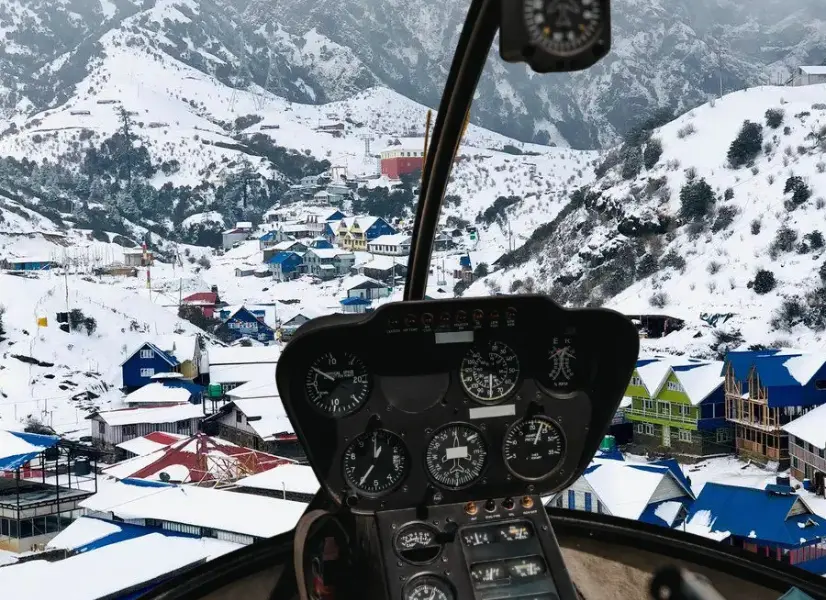
Tihar is a family festival, which is exactly why a helicopter can help. It adds a Himalayan morning without giving up a festival evening, and turns a long road day into a few hours in the air for travelers with limited time, diaspora families, and multi-generational groups.
One honest note first: the helicopter tours featured by Go Heli Services operate during daylight hours. Plan your flight for the morning or daytime, and enjoy Tihar’s illuminated streets on foot after sunset.
Best Tihar Helicopter Routes
The table below uses Go Heli’s currently listed starting prices. Prices are per shared seat unless stated otherwise.
Prices are indicative starting prices based on currently listed Go Heli packages; final quotes depend on route, passenger numbers, aircraft availability, weather, permits, and operating conditions. Private charters start at US$1,800 for short scenic routes; Everest private charters are typically US$5,500–6,000. Confirm pricing before booking.
Shared Seat or Private Charter?
For solo travelers and couples, a shared seat is usually better value. As a rough guide, one Everest shared seat is US$1,700; two cost US$3,400; a private charter is typically US$5,500–6,000. Private becomes better value at four or five passengers, subject to weight limits. Charter prices are per helicopter, not per person, and high-altitude aircraft may not carry five adults plus full luggage.
Booking and Weather
- Book 4–8 weeks ahead when possible. For Tihar 2026, ask about last-minute availability.
- Fly in the morning. Mountain weather usually builds by late morning.
- Keep a buffer day for holiday traffic, ATC delays, and weather.Send accurate weights; high-altitude flights have strict payload limits.
- Carry your passport and confirm the cancellation policy in writing.
A helicopter tour suits travelers with limited time, families with children or older relatives, diaspora visitors who want the mountains without losing a family day, and photographers. It is not right for budget travelers or anyone who expects a flight to be guaranteed regardless of weather.
How to Combine Tihar with a Helicopter Day
Four-day plan (2026 dates):
For more route guidance, read is a helicopter tour in Nepal worth it and helicopter tour vs heli trek. Pilgrims may also find our helicopter pilgrimage tours useful, and families can compare options in helicopter tours for special occasions.
Why Book with Go Heli Services
Go Heli Services arranges helicopter tours and charter flights across Nepal in coordination with licensed operators. Popular destinations include Everest, Annapurna, Muktinath, Gosaikunda, Kalinchowk, and Pokhara. We assist with route planning, permits, transfers, and booking, and we tell you honestly when a flight is not a good idea. Send your dates, group size, and preferred route for a fixed quote.
When is Tihar in Nepal in 2026?
Tihar 2026 runs 7–11 November. Laxmi Puja is 8 November, Bhai Tika is 11 November, and the government holiday runs through 12 November.
What are the five days of Tihar?
Kaag Tihar (crow), Kukur Tihar (dog), Gai Tihar (cow), Goru Tihar/Govardhan Puja/Mha Puja, and Bhai Tika (siblings). Laxmi Puja falls on Kukur Tihar in 2026.
When is Laxmi Puja in 2026?
Laxmi Puja is Sunday 8 November 2026, the main night of lights.
When is Bhai Tika in 2026?
Bhai Tika is Wednesday 11 November 2026, the final and most family-focused day.
What is Kukur Tihar?
Kukur Tihar honors dogs with tika, marigold garlands, and special food for their loyalty and their connection with Yama in Hindu tradition.
What is Kaag Tihar?
Kaag Tihar is the first day, dedicated to the crow, traditionally a messenger of Yama. Families offer food on rooftops and ledges.
Is Tihar the same as Diwali?
No. Tihar is Nepal’s distinct five-day festival with animal days, Bhai Tika, and Mha Puja/Nepal Sambat. Diwali is a broader family of festivals that shares lamps, sweets, and Laxmi Puja.
Why is Tihar celebrated in Nepal?
It honors Yama, Laxmi, animals, and siblings — a festival of gratitude, light, and family.
What is Mha Puja?
Mha Puja is the Newar worship of the self on the fourth day of Tihar. It honors the life force within each person and marks the Nepal Sambat new year.
What is Nepal Sambat 1147?
Nepal Sambat is the Newar calendar era. The year 1147 begins on 10 November 2026.
Can tourists celebrate Tihar in Nepal?
Yes, especially if invited by a host family. Ask before photographing, dress modestly at temples, and accept tika or prasad graciously.
Where is the best place to experience Tihar?
Kathmandu is most convenient, Patan and Bhaktapur are best for Newar culture, and Pokhara is the most relaxed. Lumbini, Janakpur, and the mountain regions offer quieter alternatives.
What is the weather like in Nepal during Tihar?
November is post-monsoon: clear skies, mild days, and cool evenings in Kathmandu and Pokhara. At altitude, mornings and nights are cold.
Are shops and restaurants open during Tihar?
Tourist hotels and many restaurants stay open, but government offices, banks, and some local shops close from 8 to 12 November. Carry cash and confirm locally.
Can I book a helicopter tour during Tihar?
Yes, but book early. Shared seats and private charters fill quickly. Morning departures are best, keep a buffer day, and note that flights operate in daylight only.
Final Checklist
- Confirm dates and local puja timings with your hotel or host.
- Book hotels, flights, and helicopter seats 4–8 weeks ahead when possible; ask about last-minute availability for 2026.
- Keep a buffer day for weather and holiday delays.
- Pack layers, a warm jacket, sunglasses, sunscreen, and comfortable shoes.
- Carry small cash for Deusi/Bhailo groups, tips, and purchases.
- Ask before photographing people, homes, or rituals; accept tika and prasad graciously.
- Remove shoes before entering homes and temples, and bring a small gift if invited.
- Respect local rules on fireworks and alcohol.
- Check the weather before trekking or flying, and confirm your insurance covers your planned activities and helicopter flights, subject to policy terms.
Festival dates and holiday information were checked against the Kathmandu Metropolitan City calendar and Government of Nepal public holiday announcements, and cross-checked with the Nepal Tourism Board and local guides. Rituals vary by region and family; confirm timings with your host or guide.
Ready to plan your Tihar trip? Talk to Go Heli Services about helicopter tours, festive charters, and mountain flights during your stay in Nepal.

Go Heli Services