

A helicopter return from Everest trek replaces the walk back to Lukla with a single flight out of the Khumbu. You still trek up. You still earn the altitude. But instead of spending three to four more days descending to Lukla and gambling on a fixed-wing connection, you leave from Gorakshep, Pheriche, or another pickup point. Under suitable weather and operating conditions, a morning departure can bring you to Kathmandu the same day.
That convenience has a price, and the price changes sharply depending on where you fly from. It also comes with weight limits, weather risk, and a set of 2026 helicopter rules that many trekking blogs still describe inaccurately. This guide covers the return leg only: pickup points, real costs, how to add a flight to a trek you have already booked, what happens on return day, and when walking out is still the better choice.
This is the return-leg guide, not a full trek itinerary. If you want the day-by-day walk from Lukla to Everest Base Camp, read the Everest Base Camp Trek with Helicopter Return guide. If you already know you want the whole package, the 11-day Everest Base Camp trek with helicopter return starts from US$2,280 per person.
What Is a Helicopter Return from Everest Trek?
A helicopter return is a one-way transfer from a high Khumbu pickup point to Kathmandu. It is not a sightseeing tour, and it is not a rescue. You book it in advance, pay for it like any other flight, and use it to end your trek on a fixed date.
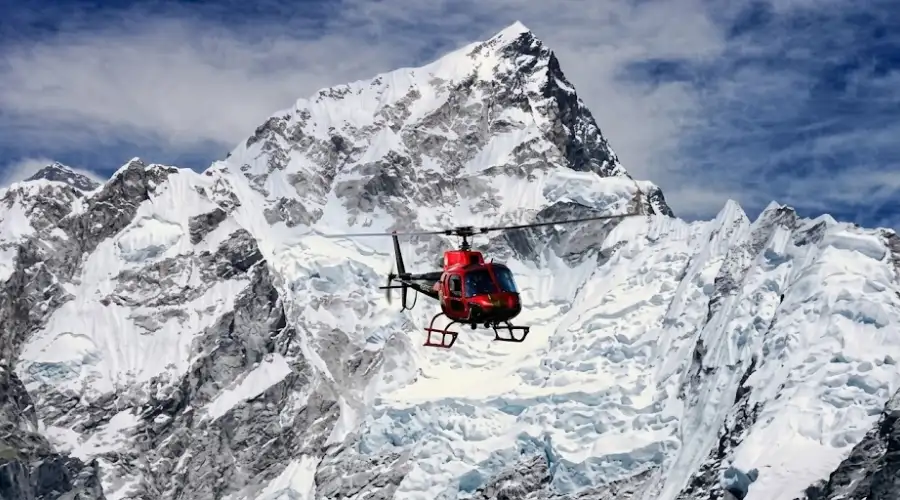
The usual pattern is simple. You walk to Everest Base Camp, sleep at Gorakshep, climb Kala Patthar for sunrise if the weather allows, and board a helicopter the next morning. The aircraft descends through the Khumbu Valley, usually stops briefly at Lukla to refuel, and continues to Tribhuvan International Airport in Kathmandu. If you are lower down, the helicopter can pick you up at Pheriche, Dingboche, Tengboche, Namche, or Lukla instead.
How the Return Leg Works
The flight does not replace the trek, the permits, or the acclimatization. It replaces the descent. You still need a Sagarmatha National Park permit, the Khumbu Pasang Lhamu Rural Municipality permit, and a licensed guide under national trekking rules; confirm how the Khumbu municipality is applying the guide rule for your dates. You still need to walk up slowly enough to avoid altitude illness.
What changes is the final three to four days. Instead of Gorakshep to Lobuche, Pheriche, Namche, and Lukla, you fly. That can matter enormously if you have an international flight to catch, a knee that has had enough, or a fixed number of holiday days.
Who Should Fly Out – and Who Should Walk?
A helicopter return suits trekkers who value time more than money, travelers with knee, hip, or ankle problems, older trekkers who have already pushed their limits, and anyone whose itinerary cannot absorb a two- or three-day Lukla weather backlog. It also suits photographers who want a final aerial view of Everest, Lhotse, Nuptse, and Ama Dablam.
It is a poor fit for budget travelers, purists who want to walk the full route, and anyone who expects the flight to be guaranteed. Weather can ground a helicopter just as it grounds a plane. If you are trekking in the monsoon and have no buffer, a helicopter is an expensive gamble.
What a Helicopter Return Is Not
A helicopter return is a planned, paid transfer, not an emergency rescue, a sightseeing tour from Kathmandu, or a replacement for travel insurance. It also does not include a landing at Everest Base Camp. If you become ill at altitude, descend and seek medical help; do not wait for a pre-booked flight.
Helicopter Return from Everest Trek at a Glance (2026)
Everest Trek Helicopter Pickup Points: 7 Options Compared
The pickup point is the single biggest decision on the return leg. It changes the price, the flight time, the weather risk, and how much you still have to walk. The table below uses shared-seat and private-charter starting prices from Go Heli’s route pages, checked on 4 November 2026.
Airborne times are estimates. Total door-to-door time is typically 1.5–3 hours, depending on pickup point, the Lukla refuel stop, passenger shuffles, and weather. Private charter prices are per helicopter, not per person, and are subject to passenger and baggage weight.
Gorakshep: Best for EBC and Kala Patthar
Gorakshep is the standard pickup for trekkers who have just finished Everest Base Camp and Kala Patthar. It is the highest and most convenient option, and it saves the most walking. You sleep at Gorakshep, climb Kala Patthar at sunrise if conditions allow, then walk five to ten minutes to the helipad.
The trade-off is altitude and weather. At 5,164 m, the helicopter is operating near its performance limit, so passengers and bags may be split across shuttles. Cloud, wind, or snow can delay the flight. Gorakshep is also the most expensive shared seat. For the full route, see the Gorakshep to Kathmandu helicopter return.
Lobuche: The High-Altitude Alternative
Lobuche is a useful alternative when Gorakshep is unavailable, overcrowded, or closed by weather. It is still very high, so it is not a low-altitude escape, but it can be easier to reach if you are already descending. The flight to Kathmandu typically takes 1.5–2 hours because of the routing and refuel stop.
Choose Lobuche if your guide recommends it or if the Gorakshep pad is not operating. Do not choose it assuming the weather will automatically be better; at 4,940 m, it is only marginally lower. See the Lobuche to Kathmandu helicopter flight.
Pheriche: A Lower-Altitude Pickup Option
Pheriche is about 900 m lower than Gorakshep, which makes it a more comfortable pickup for many trekkers. The flight takes 60–90 minutes airborne, and the lower elevation can improve aircraft performance compared with Gorakshep, although actual flight availability still depends on local visibility, wind, cloud cover, and operating conditions. The cost is the same as Lobuche at US$1,350 per shared seat.
The catch is that you have to walk down from Gorakshep to Pheriche, which usually adds a day. If you were planning to descend anyway, Pheriche is a sensible place to stop and fly. It is also a good fallback if Gorakshep is fogged in. See the Pheriche to Kathmandu helicopter flight.
Dingboche: The Mid-Valley Option
Dingboche sits between Pheriche and Lobuche and is a common acclimatization stop. A helicopter from Dingboche costs from US$1,300 per shared seat and takes 50–70 minutes. It is a good choice if you want one more night at altitude or if your itinerary already includes a rest day there.
The village is lower than Gorakshep but higher than Pheriche, so it does not solve every weather problem. It does, however, shorten the walk out compared with Pheriche while costing less than Gorakshep. See the Dingboche to Kathmandu helicopter return.
Tengboche: The Cultural Stop
Tengboche is known for its monastery and its Everest views. A helicopter from here costs from US$1,250 per shared seat and takes 50–65 minutes. It is a lower, more comfortable pickup than Dingboche, and it saves roughly two days of walking to Lukla.
This is a good option for trekkers who want a slower descent and a cultural stop, or who are willing to trade a lower price for a longer walk. It is not the fastest way out from EBC. See the Tengboche to Kathmandu helicopter return.
Namche Bazaar: The Budget Pickup
Namche is the biggest village in the Khumbu and a natural place to end a shortened trek. A shared helicopter from Namche costs from US$1,150 and takes 45–55 minutes. It saves one to two days compared with walking to Lukla.
The compromise is obvious: you have to walk from Gorakshep to Namche, which usually takes two days. If you are already descending and want to save money, Namche is a good balance. If your priority is speed, fly from Gorakshep or Pheriche. See the Namche to Kathmandu helicopter flight.
Lukla: The Cheapest Helicopter Exit
Lukla is the cheapest helicopter return at US$750 per shared seat, but by the time you reach Lukla you have already completed the walk out. The main value is avoiding a fixed-wing cancellation or a long wait when planes are grounded.
If your scheduled Lukla flight is canceled, a helicopter seat can get you to Kathmandu the same day. If you are still at Gorakshep, flying to Lukla first and then to Kathmandu is usually slower and more expensive than a direct return. See the Lukla to Kathmandu helicopter flight.
Which Pickup Point Should You Choose?
Not sure which pickup point fits your itinerary? Contact Go Heli Services with your trek dates, group size, and preferred pickup. We will confirm current availability and the exact pad.
Helicopter Return from Everest Trek Cost in 2026
Short answer: shared seats start at US$750 from Lukla and US$1,425 from Gorakshep; private charters range from US$2,600 to US$5,200 per helicopter.
Prices for the return leg are per shared seat, one way, and per private helicopter. The table below uses the current Go Heli route pages. It also shows the per-person cost of a private charter at full capacity, which is often the number trekkers forget to calculate.
Prices were checked against Go Heli’s route pages on 4 November 2026. They are starting prices, not fixed fares. Season, demand, fuel, aircraft type, passenger weights, and the number of shuttles can change the quote. Airborne times do not include refuelling, transfers, or waiting; allow 1.5–3 hours door-to-door. Always ask for the final price in writing.
Shared Seat vs Private Charter: Break-Even by Group Size
This is where many groups overspend. A private charter is priced per helicopter, not per person. At four or five passengers, it is often cheaper per person than buying individual shared seats. The table below uses the Gorakshep route as an example.
The break-even is usually four passengers. At Lukla, where the private charter is US$2,600, the break-even is also four passengers. A private charter gives you more control over departure time and luggage, but it does not guarantee better weather. Confirm the maximum passenger count and baggage allowance before you pay.
Travelling with a group? Request a private charter quote and compare the per-person cost with shared seats before you book.
What Is Included and What Is Not?
“Included” is not a universal standard. Some quotes include airport tax and some add it later. Some include 15 kg and some restrict high-altitude sectors to 10 kg. Ask for a written breakdown before you pay a deposit.
Is It Worth It? Cost per Day Saved
Short answer: it is worth it when the saved days, reduced knee strain, or a protected international connection are worth roughly US$200–250 per day to you.
A helicopter return is not cheap, and it is not supposed to be. The honest comparison is between the helicopter and the cost of walking out plus a Lukla flight. From Gorakshep, walking to Lukla takes three to four days. Those days cost money in lodges, meals, guide and porter time, and the Lukla flight itself.
A realistic walking exit from Gorakshep costs roughly US$400–650: three to four nights of lodging and food, guide and porter days, and a fixed-wing ticket. A US$1,425 helicopter seat is therefore a premium of roughly US$800–1,000. If it saves four days, that is about US$200–250 per day saved. At four passengers on a private charter, the per-person premium falls to roughly US$650–900, or US$160–225 per day.
That can be excellent value if your alternative is missing an international flight, paying for extra hotel nights in Kathmandu, or damaging a knee. It is poor value if you have plenty of time and a tight budget. The helicopter is also not a guarantee: weather can still cancel the flight, so the premium buys time and comfort, not certainty.
What Changes the Price
- Season. October–November and March–May are peak. Demand is high and seats fill early.
- Group size. Shared seats are cheaper for solo travelers and couples. Private charters are cheaper per person at four or five passengers.
- Pickup point. Gorakshep is the most expensive because it is the highest and most demanding. Lukla is the cheapest.
- Passenger weight. High-altitude flights are weight-limited. Heavy groups may need extra shuttles or leave baggage behind.
- Luggage. Excess baggage can be charged or moved on a later flight.
- Aircraft and operator. Different helicopters have different payloads and operating costs.
- Fuel and repositioning. Remote pickups and one-way flights can carry a repositioning cost.
- Permits and pickup permission. High-altitude landing permissions can change, and the operator may need to move the pickup.
How to Book a Helicopter Return from Everest Trek
You can book the return leg as part of a full package or as a standalone flight. The important thing is coordination: your trekking guide, your luggage, and the helicopter operator all need to agree on the same pickup point and date.
If You Book a Full Package
The simplest option is a complete trek with the return included. Go Heli’s Everest Base Camp Trek with Helicopter Return starts from US$2,280 per person and includes the trek logistics, permits, guide, porter, lodges, and the helicopter return. You do not have to negotiate separately with a trekking agency and a helicopter company. The itinerary is built around the flight; ask how the operator handles a weather delay.
This is the right choice if you want one company to handle the whole trip and you are happy with a fixed itinerary. It can also be better value for solo travelers and couples, because the ground costs are bundled.
If You Already Booked with Another Agency
You can still add a helicopter return. Ask your trekking agency to release you at Gorakshep or Pheriche and confirm that you will not be charged for the unused descent days. Get the change in writing, including the date and pickup point.
Then book the helicopter directly with Go Heli. You will need to share your passport details, pickup point, preferred date, group size, passenger weights, and baggage weights. Your guide should speak with the helicopter coordinator the day before the flight to confirm the weather window and the exact helipad.
Do not assume your trekking agency will automatically organize the helicopter. Some agencies can, some cannot, and some add a markup. Compare the direct quote with the agency quote.
If You Are Trekking Independently
Independent trekkers can book a seat, but “independent” in the Khumbu does not mean free of rules. You still need the two Khumbu permits. National rules require a licensed guide, although enforcement in the Khumbu has varied; confirm with the municipality or your agency. A helicopter return does not bypass those requirements.
For 2026, budget NPR 3,000 for the Sagarmatha National Park permit, plus any 13% VAT charged at the issuing counter (about NPR 3,390 total in Kathmandu), and NPR 3,000 (roughly US$23) for the Khumbu Pasang Lhamu Rural Municipality permit. The Khumbu municipality permit has replaced TIMS in local practice, but the Nepal Tourism Board’s TIMS page still lists Everest Base Camp under its guide-and-TIMS rule. The rules are contested and enforcement varies, so confirm with the municipality, NTB, or your agency before you travel; do not pay for a TIMS card unless the issuing office requires one. See the NTB park fee table for the base park fee.
You will also need a local contact who can reach you at the pickup point. The operator needs to know where you are staying, how to find you, and how to contact you if the flight time changes. Build in a buffer day, especially in peak season.
What to Confirm in Writing
- The exact pickup pad and a backup pad if the first one is closed.
- The flight date and a backup date.
- Shared seat or private charter, with passenger names.
- Passenger weights and baggage weights.
- The full price, including airport tax and excess baggage.
- The weather cancellation, reschedule, and refund policy.
- The name of the licensed operator, aircraft type, and insurance.
- Who is responsible for permits and the guide.
- The meeting time and local contact number.
- Whether a Kala Patthar landing or overfly is included — and that it is weather-dependent.
How Far in Advance to Book
In October–November and March–May, book two to four weeks ahead. Seats on the Gorakshep route are limited, and groups of four or five should book earlier to secure a private charter. In the shoulder months, one to two weeks is usually enough. Last-minute seats exist, but you will pay for the convenience and may not get your preferred pickup.
Do not book a helicopter for the same day as your international departure. Weather delays are real, and a missed long-haul flight costs far more than a buffer night in Kathmandu.
Already booked your Everest Base Camp trek? You can arrange a standalone helicopter return without booking the entire trek again. Contact Go Heli Services with your preferred pickup point and travel date.
Return Day: Gorakshep to Kathmandu Step by Step
The return day starts early. Weather windows in the Khumbu are best in the morning, and the helicopter may need to complete several shuttles before it can leave the valley. The timeline below is a realistic plan, not a guarantee.
Airborne time on this route is usually 45–60 minutes. The timeline allows about 1 hour 45 minutes door-to-door, including a 30-minute refuel stop and ground handling; shuttles or weather can extend it. If you are flying from Pheriche, Dingboche, Tengboche, Namche, or Lukla, the day is shorter because you are already lower. The same principles apply: be ready early, keep your bags light, and do not plan a tight connection.
What the Flight Is Like
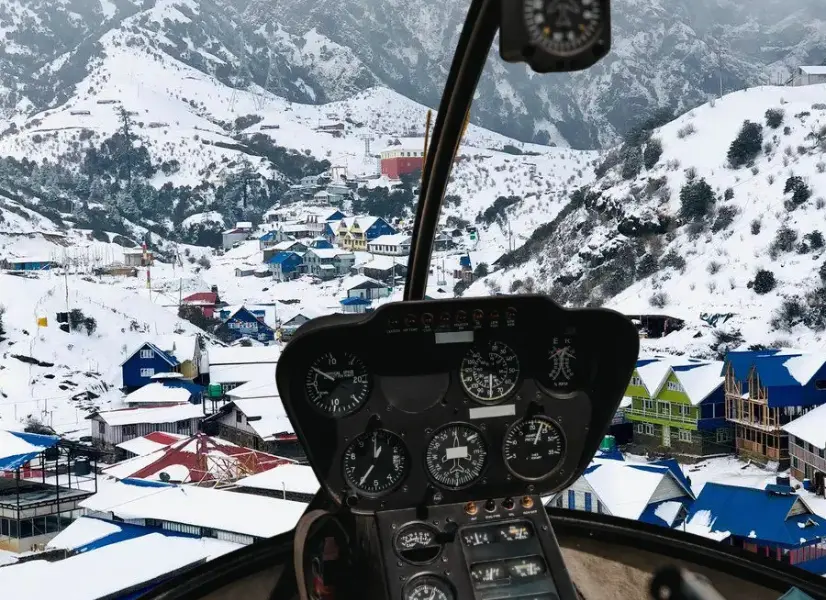
The helicopter lifts off from a high, narrow pad and follows the valley down. You will see the Khumbu Glacier, the jagged ridge of Nuptse, the dark pyramid of Everest, and the terraced fields around Lukla. The cabin is noisy, so you will wear a headset. Layers matter: it is cold at altitude and warmer in Kathmandu.
If the aircraft needs to shuttle passengers, you may wait at the pickup point or at Pheriche while the first group flies. This is normal. It is also why the total journey can take longer than the airborne time suggests.
What Happens if Weather Cancels
The pilot and operator decide whether the flight can operate. If the weather is unsafe, you wait, reschedule, or descend to a lower pickup point. Some operators will move you to Pheriche or Lukla; others will refund according to their policy.
Ask about the cancellation policy before you book. “Full refund” and “free reschedule” are not the same thing, and neither covers the cost of an extra night in a lodge or a missed international flight. Keep at least one buffer day in Kathmandu, and do not treat the helicopter as a guaranteed connection.
Luggage, Weight and Shuttle Rules
Weigh your bag before you leave Kathmandu and again at the pickup point. Do not assume the limit is flexible. If you are a group of five with heavy duffels, the operator may need two shuttles, which can change the schedule and the price.
Everest Helicopter Rules in 2026
Helicopter rules in the Khumbu have been contested since late 2024. Some articles still describe a blanket ban that no longer reflects operations. Others pretend nothing changed. The truthful position is more complicated, and it matters for your pickup.
The 2025 Khumbu Restrictions, Explained
In December 2024, the Khumbu Pasang Lhamu Rural Municipality and the Sagarmatha National Park office announced restrictions on commercial helicopter flights in the Everest region, effective 1 January 2025. The stated concerns included noise, wildlife disturbance, and the effect of sightseeing flights on the local trekking economy.
The decision was disputed. The Civil Aviation Authority of Nepal and the Airlines Operators Association of Nepal opposed it, and the national park office later allowed flights to continue with permission, fee payment, and compliance with existing laws. The local municipality maintained its own position, and the dispute continued into 2026.
As of November 2026, helicopter transport to and from Lukla is operating, and several operators report that high-altitude sightseeing landings have resumed. There is no single public document that approves every high-altitude landing site. Availability of each pickup remains subject to applicable aviation permissions, Sagarmatha National Park and local municipal conditions, and the operator’s go/no-go decision on the flight date. That is why the only safe approach is to confirm the specific pickup and permission for your flight date.
Useful references: the Sagarmatha National Park notice reported by HimalPress, the Kathmandu Post report on the local and federal dispute, the CAAN Aeronautical Information Publication, and the Civil Aviation Authority of Nepal.
What the Current Rules Mean for Your Pickup
- Do not assume a Kala Patthar landing. It may be possible, but it is not guaranteed and can be suspended.
- Do not assume Gorakshep will always be available. The operator may move the pickup to Pheriche or Lukla.
- Confirm the exact pad in writing. “Everest region pickup” is not specific enough.
- Keep your plans flexible. A lower pickup may be the difference between flying out today and waiting another day.
- Book with a company that coordinates locally. Rules can change between the time you book and the time you fly.
Best Time for an Everest Trek Helicopter Return
Best Time of Day
Fly in the morning. Valley clouds and wind build through the day, and the first rotations have the best chance of a clear window. If you are at Gorakshep, do not try to combine a late Kala Patthar climb with an early flight. Confirm the departure time with your guide and be at the helipad ready to board.
Monsoon and Winter Realities
The monsoon is the least reliable season for any flight in the Khumbu. Cloud can sit in the valley for days, and the helicopter may not be able to reach Gorakshep or Pheriche. If you must travel in June–September, keep two or three buffer days and accept that the flight may not happen.
Winter is clearer but colder. Snow can close the helipad, and morning fog can delay the first rotation. The helicopter can sometimes fly when a fixed-wing aircraft cannot, but it cannot fly in zero visibility. Treat winter as a good window with a weather caveat, not a guarantee.
Helicopter Return vs Other Ways to Leave Everest
“Same day” assumes suitable weather, aircraft availability, and no extended shuttles. It is not a guarantee.
Helicopter Return vs Full Everest Helicopter Tour
A full Everest Base Camp helicopter tour starts and ends in Kathmandu. It is a sightseeing flight, often with a Kala Patthar landing and a breakfast stop, and it does not involve trekking. A helicopter return is a one-way transfer at the end of a trek. They are different products with different prices, rules, and expectations.
If you want to see Everest without walking, book the tour. If you want to earn the trek and fly out, book the return. Do not book a return seat expecting a scenic tour with landings; the priority is getting you to Kathmandu.
Helicopter Return vs Walking Back
Walking back is cheaper, slower, and more immersive. You see villages you missed on the way up, spend more time with your guide, and avoid the carbon cost of a helicopter. It is also harder on the knees and more exposed to weather and Lukla delays.
The helicopter is the right choice when time, joints, or a fixed international flight matter more than the cost. It is the wrong choice when the walk is the point of the trip.
Safety, Altitude and Insurance
Altitude on the Return
You are flying down, not up, so the return leg is generally lower risk than the ascent. But you are still at 5,164 m at Gorakshep, and altitude sickness can develop suddenly. If you have symptoms of acute mountain sickness, do not wait for a scheduled flight. Descend and seek medical help. A helicopter is not a treatment for altitude illness.
Insurance That Actually Covers You
Your travel insurance should cover trekking in Nepal, helicopter evacuation up to at least 6,000 m, and any pre-existing conditions you have declared. Check the exclusions for “sightseeing flights” and “planned helicopter transfers.” A planned return is usually not claimable as a rescue.
Carry your insurer’s emergency contact number and your policy number. If you need a rescue, the insurer may require pre-authorization, and the operator may require a payment guarantee. Do not assume that a helicopter will come first and the paperwork will follow.
Who Should Not Fly
Talk to your doctor before booking if you have unstable heart or lung disease, recent surgery, uncontrolled high blood pressure, or a condition that makes high altitude unsafe. Pregnant travelers should get medical advice and check the operator’s policy. Anyone with severe AMS, HACE, or HAPE needs emergency medical care, not a scheduled scenic flight.
Safety and Operator Choice
Nepal’s high-altitude helicopter operations use aircraft such as the Airbus H125/AS350 and experienced mountain pilots. The operator makes the final call on weather, load, and routing. Ask who the licensed operator is, what aircraft is used, and what passenger insurance is in place. Do not choose a flight on price alone.
Why Book Your Return Leg with Go Heli Services?
Go Heli Services is a Kathmandu-based booking agency, not the aircraft operator. We coordinate the seat or charter, the pickup point, the schedule, and the guest communication. The licensed air operator flies the aircraft and makes the safety and weather decisions. That distinction matters.
Go Heli has a 4.9/5 rating from 20+ reviews and has coordinated 500+ flights as of 2026; see the Go Heli reviews page. The published route prices are transparent, and the team can explain the trade-offs between Gorakshep, Pheriche, Namche, and Lukla. We do not operate aircraft, employ pilots, or provide helicopter rescue or medical evacuation.
How Go Heli Coordinates a Return
A typical booking follows six steps. The exact sequence depends on the route and the licensed operator.
- You send your trek dates, pickup point, group size, passenger weights, and baggage weights.
- We check availability with the licensed operator for your preferred date and a backup date.
- We confirm the exact pad, reporting time, inclusions, and cancellation terms in writing.
- You pay the deposit or full fare set out in the quote.
- We reconfirm with your guide 24–48 hours before the flight and again in the morning.
- If weather changes, we explain the lower-pickup, reschedule, or refund options under your booking terms.
We do not control the weather or the pilot’s decision. We make sure you know who is deciding, when, and what happens next.
For the inbound leg, read the Kathmandu to Lukla helicopter cost guide. For shared versus private pricing, see Everest helicopter tour cost: shared vs private charter. For a broader value comparison, read is a helicopter tour in Nepal worth it.
To get a quote, send your trek dates, pickup point, group size, passenger weights, and baggage weights through the contact page. If you want the full trek arranged, start with the Everest Base Camp Trek with Helicopter Return.
Frequently Asked Questions About Everest Helicopter Returns
Can a helicopter pick me up at Everest Base Camp?
No. Under current rules, helicopters do not land at Everest Base Camp. They overfly the base camp and pick up at Gorakshep, which is about 5,164 m and the nearest practical helipad for EBC trekkers.
What is the best pickup point for a helicopter return from Everest trek?
Gorakshep is best if you have just finished EBC and Kala Patthar and want the shortest walk. Pheriche is lower and can offer a better weather window, but that is not guaranteed. Namche and Lukla are cheaper but require more walking.
How much does a helicopter return from Everest trek cost in 2026?
A shared seat from Gorakshep to Kathmandu starts at US$1,425. Pheriche and Lobuche start at US$1,350, Dingboche at US$1,300, Tengboche at US$1,250, Namche at US$1,150, and Lukla at US$750. Private charters range from US$2,600 to US$5,200 per helicopter.
How long is the flight from Gorakshep to Kathmandu?
The airborne time is usually 45–60 minutes, plus a refuel stop at Lukla. Door-to-door, allow two to three hours including the walk to the helipad, weight check, boarding, and the refuel stop.
Can I book only the helicopter return if I already have a trek booked?
Yes. Ask your trekking agency to release you at Gorakshep or Pheriche, confirm that unused descent days will not be charged, and book the helicopter directly. Get the pickup point, date, and price in writing.
Is a shared seat or a private charter better?
For one or two passengers, a shared seat is usually cheaper. For four or five passengers, a private charter is often cheaper per person and gives you more control over timing and luggage. Compare the per-person private price before you book.
How much luggage can I take on the helicopter?
Plan for 10–15 kg total, including hand baggage. High-altitude sectors may be limited to 10 kg. Soft bags only; no hard suitcases or trekking poles. Declare accurate passenger and baggage weights in advance.
What happens if the helicopter cannot fly because of weather?
The operator may delay, reschedule, or move you to a lower pickup point. Refunds and reschedules depend on the policy you booked.
Do I need travel insurance for a helicopter return?
Yes. Your policy should cover trekking in Nepal and helicopter evacuation up to at least 6,000 m. A planned helicopter return is not an emergency rescue and is usually not claimable as one. Check the exclusions before you buy.
Is a helicopter return safe at 5,000 m?
High-altitude helicopter flights are routine in the Khumbu when operated by licensed companies with experienced mountain pilots. The risks are weather, load, and altitude illness. Disclose your health conditions and follow the pilot’s instructions.
Do I still need permits and a guide?
Yes. The helicopter does not replace the Sagarmatha National Park permit, the Khumbu Pasang Lhamu Rural Municipality permit, or the guide requirement. National rules require a licensed guide. The Khumbu municipality permit has replaced TIMS in local practice, but NTB’s TIMS page still lists EBC under its guide-and-TIMS rule. Confirm the current local requirement before you travel. See the NTB park fee table for the base park fee.
Is a helicopter return from Everest trek worth it?
It is worth it if you value three to four saved days at roughly US$200–250 per day, have knee or joint problems, or cannot risk a Lukla weather backlog. It is not worth it if you have plenty of time and a tight budget, or if you expect a guaranteed flight.
Can I fly from Pheriche or Namche instead of Gorakshep?
Yes. Pheriche is lower and can offer a better weather window, but that is not guaranteed; you must also walk down from Gorakshep first. Namche is cheaper again but adds two days of walking. Choose the pickup that matches your time, budget, and knees.
Can I do a helicopter return in one day from Kathmandu?
No. A helicopter return is a one-way flight from the Khumbu at the end of a trek. If you want a same-day Everest experience from Kathmandu, book an Everest Base Camp helicopter tour instead.
Final Checklist Before You Book
Before booking
- Confirm the exact pickup pad and a backup pad.
- Confirm shared seat or private charter, with passenger names.
- Share accurate passenger and baggage weights.
- Ask what is included: airport tax, excess baggage, insurance, and permits.
- Get the weather cancellation and refund policy in writing.
- Confirm the licensed operator, aircraft type, and insurance.
- Confirm that your guide and permits are in order.
- Keep at least one buffer day before your international flight.
Before the flight
- Pack to 10–15 kg and use a soft bag.
- Keep your passport, insurance details, and medication in your day bag.
- Charge your phone and carry a power bank.
- Confirm the meeting time and local contact number.
- Check the weather forecast, but accept that the pilot makes the final call.
- Be ready early; the first rotation has the best weather window.
On return day
- Eat a light breakfast and drink water.
- Do not attempt a late Kala Patthar climb if it clashes with your flight.
- Weigh your bag before you leave the lodge.
- Stay with your bags at the Lukla refuel stop.
- Keep your expectations flexible; mountain weather writes its own schedule.
A helicopter return from Everest trek is one of the most practical upgrades in Nepali trekking, but only when you choose the right pickup, understand the weight rules, and plan for weather. If you want to fly out from Gorakshep, Pheriche, or Lukla in 2026, contact Go Heli Services with your dates and group details for a current quote.
Operational details are coordinated by the Go Heli operations team. Last updated: 4 November 2026. Prices and operational details were checked against current Go Heli route pages, the NTB park fee table, the NTB TIMS page, and the CAAN Aeronautical Information Publication on 4 November 2026. This guide is not a substitute for a written quote, the operator’s safety briefing, or current government advice. About Go Heli.

Go Heli Services